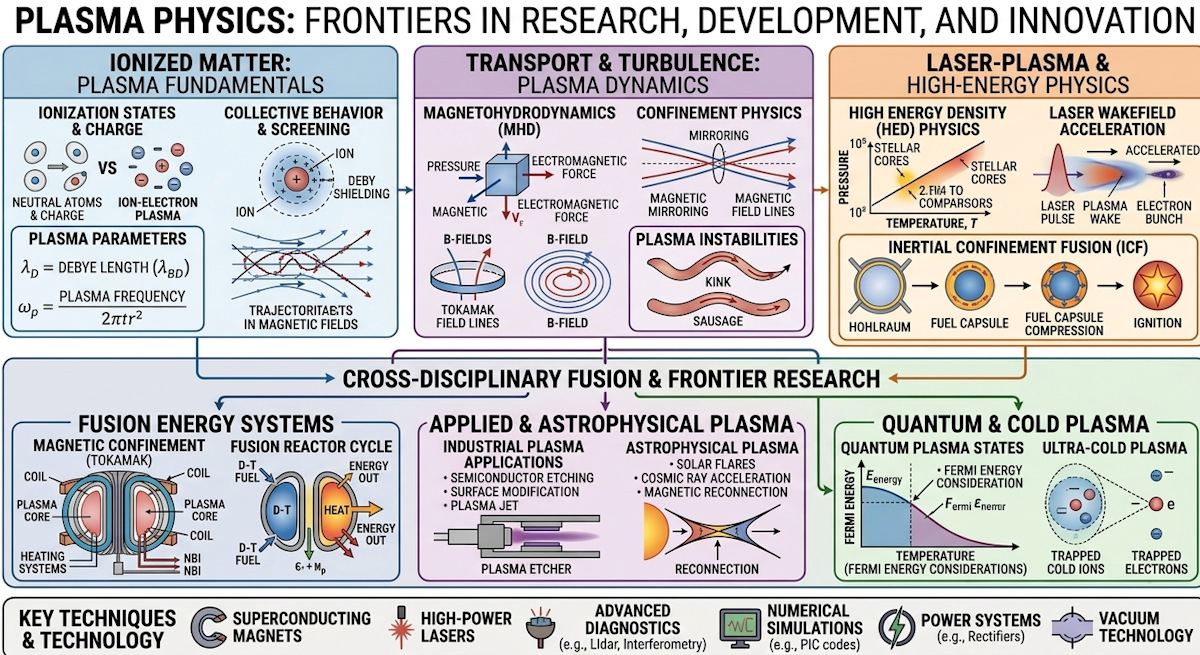
Plasma Physics
Plasma Physics focuses on the study of ionized gases—often called the "fourth state of matter" — where electrons are stripped from atomic nuclei. Because it consists of freely moving charged particles, plasma interacts heavily with electromagnetic fields, giving rise to complex, collective behaviors not found in neutral gases.
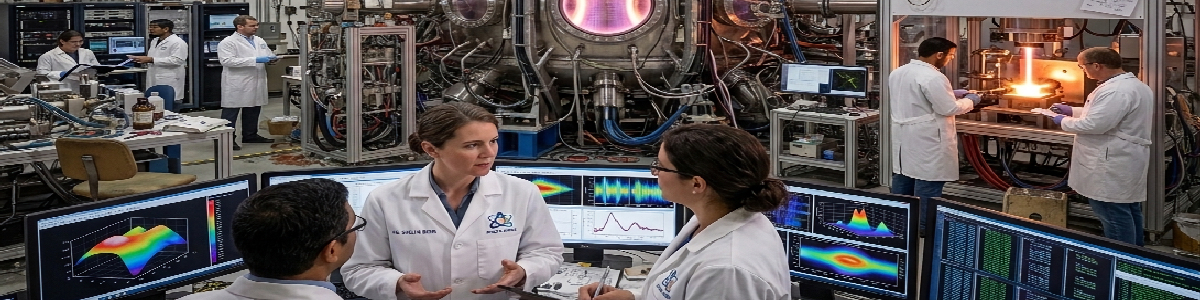
The Chandrasekhar Magnetohydrodynamics & Plasma Fusion Center
 Serves as the high-temperature confinement and magnetic plasma diagnostics hub at Analex Laboratories. Named in honor of Subrahmanyan Chandrasekhar—the astrophysicist whose foundational work on stellar dynamics and plasma instability illuminated the behavior of magnetized fluids across the universe—the facility integrates advanced magnetic confinement systems with ultrafast diagnostics to investigate controlled thermonuclear fusion, space plasma phenomena, and high-energy-density states.
Core Capabilities & Equipment
- High-Temperature Magnetic Confinement Reactor Suite: Advanced toroidal and mirror confinement vessels equipped with high-field superconducting magnets sustain multi-million-degree plasmas for extended energy containment and stability studies.
- Ultrafast Thomson Scattering & Interferometry Array: High-power pulsed laser diagnostics measure local electron temperature and density profiles across microsecond timescales within turbulent plasma cores.
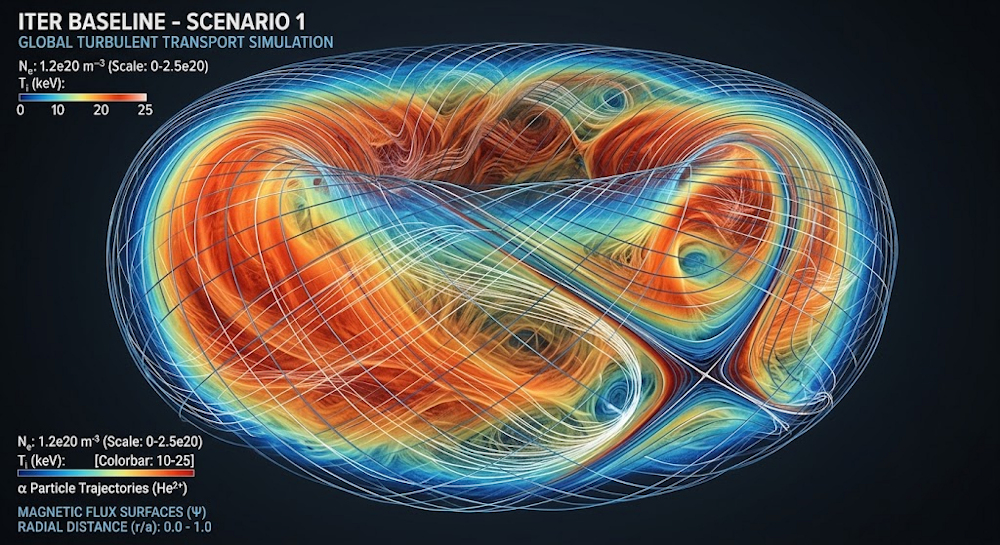
- Nonlinear Plasma Turbulence & Magnetohydrodynamic (MHD) Modeling Suite: High-performance computing clusters execute massive parallel simulations to forecast transport phenomena, magnetic reconnection events, and disruptive instabilities in confined plasmas.
- High-Heat-Flux Materials Testing Workstation: Electron-beam and plasma-gun test stands bombard advanced refractory metals and plasma-facing armor tiles with extreme thermal loads to evaluate wall degradation and erosion resistance.
At Analex Laboratories, plasma physics research focuses on understanding and controlling ionized gases to address critical scientific and industrial challenges. Consistently referred to as the "fourth state of matter," plasma consists of unbound ions and free electrons whose collective behavior is dominated by complex electromagnetic interactions. By bridging fundamental atomic physics, fluid dynamics, and electrodynamics, the consortium leads pioneer-level research in high-energy density states and magnetic field topographies.
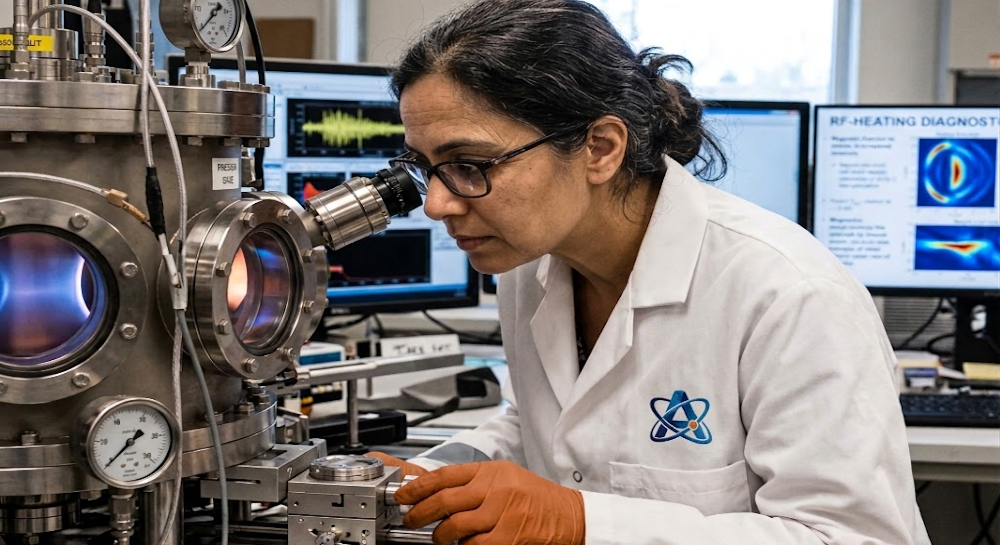
The laboratory’s flagship initiatives center on nuclear fusion energy development, exploring both Magnetic Confinement Fusion (MCF) and Inertial Confinement Fusion (ICF). Researchers at Analex optimize advanced confinement geometries—such as next-generation Tokamaks and Stellarators—using high-temperature superconducting (HTS) magnets to stabilize superheated plasma loops. Concurrently, their laser-plasma interaction teams utilize high-power pulse laser systems to achieve precise shock-wave compression in micro-target capsules, advancing the threshold parameters required for scalable, net-positive energy ignition.
Beyond fusion, Analex Laboratories drives significant discovery in space and astrophysical plasma physics. Using high-performance computational modeling alongside specialized terrestrial laboratory chambers, researchers simulate extreme cosmic environments. These efforts elucidate fundamental mechanisms like magnetic reconnection, cosmic ray acceleration, and solar wind turbulence—offering deeper insights into stellar evolution, planetary magnetospheres, and space weather forecasting.
At lower energy thresholds, the consortium converts theoretical plasma dynamics into viable industrial and environmental applications. Analex engineers lead innovations in non-thermal atmospheric plasmas, developing precision plasma etching processes for sub-nanometer semiconductor fabrication and advanced plasma jet thrusters for deep-space electric propulsion. Additionally, their applied chemistry divisions leverage cold-plasma breakdown mechanisms for environmental remediation, targeting hazardous chemical degradation and green hydrogen generation.
Integrating artificial intelligence and high-performance computing, research at Analex Laboratories continues to evolve rapidly. Machine learning models process real-time diagnostic data to predict dynamic plasma instabilities micro-seconds before occurrence, allowing automated control systems to adjust magnetic fields dynamically. This synergy between experimental diagnostics, computational modeling, and innovative technology ensures Analex remains at the absolute forefront of plasma science.