Nuclear Physics
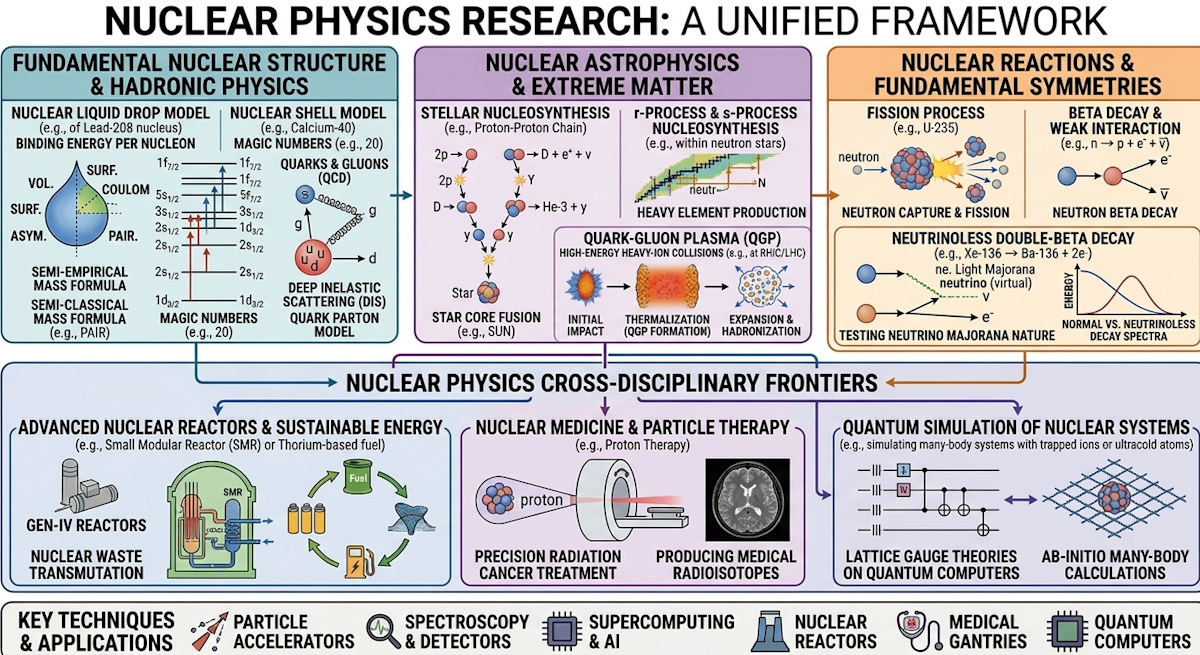
Nuclear physics focuses on understanding the fundamental structure, interactions, and extreme states of atomic nuclei and subatomic particles. Through advanced particle accelerators, high-precision detectors, and supercomputing, the field continually drives technical innovation in basic science. These fundamental insights translate directly into vital real-world applications, spanning fusion and advanced fission energy, targeted radiopharmaceutical cancer therapies, non-destructive industrial testing, and national security safeguards.
The Meitner Nuclear Structure & Reaction Dynamics Center
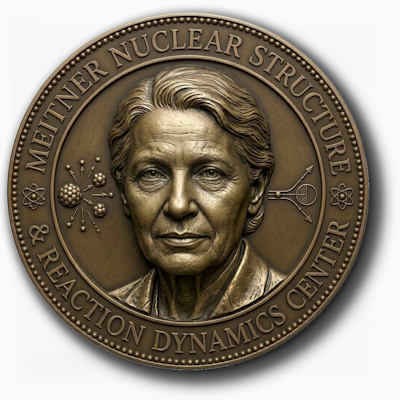 Functions as the high-precision isotope analysis and heavy-ion collision hub at Analex Laboratories. Named in honor of Lise Meitner—the brilliant physicist who co-discovered nuclear fission and uncovered the energetics of atomic transformations—the facility merges advanced particle acceleration telemetry with cryogenic detection arrays to investigate nuclear structure, nucleosynthesis pathways, and the limits of atomic stability.
Core Capabilities & Equipment
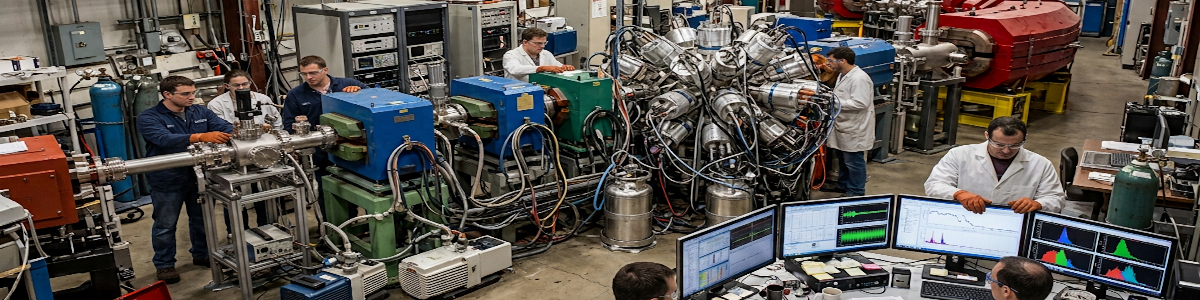
- High-Resolution Magnetic Spectrometer & Beamline Suite: Superconducting dipole and quadrupole magnet systems analyze scattered reaction products and radioactive ion beams with sub-percent momentum resolution, mapping nuclear excitation states and reaction cross-sections.
- Gamma-Ray Tracking & Scintillation Array: Dense networks of high-purity germanium (HPGe) detectors surrounded by anti-Compton shields capture cascade gamma-ray emissions, revealing high-spin states and shell-model configurations in exotic nuclei.
- Low-Background Gas-Filled Recoil Separator: Specialized electromagnetic filters isolate rare superheavy isotopes and short-lived fission fragments from intense unreacted beam backgrounds in real-time.
- Digital Pulse-Processing & Data Acquisition Workstation: High-speed, multi-channel waveform digitizers record sub-nanosecond timing and pulse-height signals from complex multi-detector arrays, optimizing coincidence sorting for rare decay events.
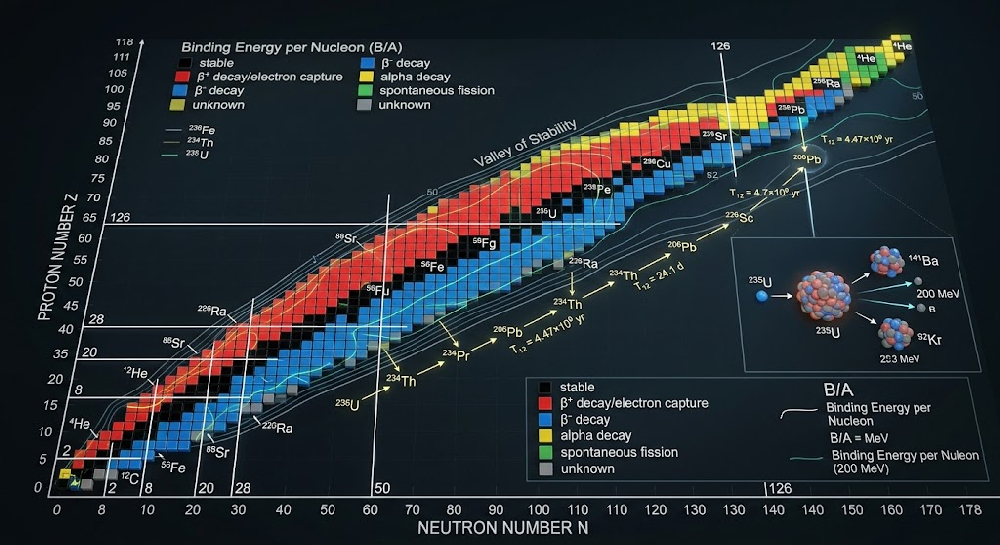
At Analex Laboratories, our research in nuclear physics centers on uncovering the fundamental mechanics of atomic structure and subatomic particle interactions. By probing the strong nuclear force, quantum chromodynamics, and nuclear shell dynamics, our theoretical and experimental physics divisions work in tandem to map the boundaries of nuclear stability. This foundational research enables our teams to study exotic isotopes, analyze nuclear fission and fusion processes, and simulate the extreme states of matter that existed moments after the Big Bang.
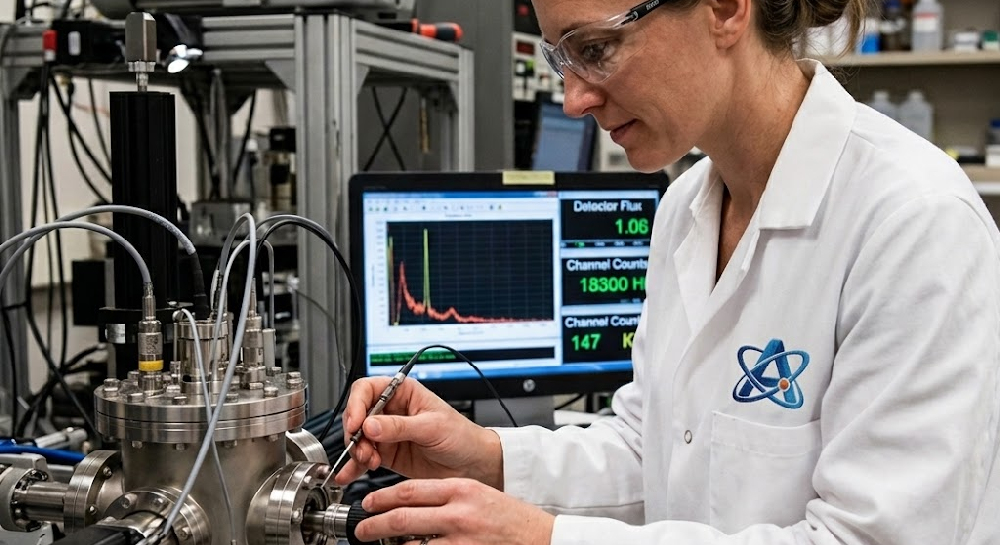
To drive these discoveries, Analex Laboratories engineers and operates advanced experimental platforms and accelerator facilities. Our technical focus includes high-luminosity particle colliders, quantum-sensored instruments, and high-purity radiation detectors capable of capturing low-energy decay signatures. Coupled with supercomputing clusters running Lattice QCD and AI-driven models, our facilities allow researchers to simulate complex, multi-body nuclear systems with unprecedented clarity.
This core scientific inquiry translates into groundbreaking real-world applications across energy and healthcare. Analex researchers actively advance next-generation energy technologies, focusing on small modular reactors (SMRs), nuclear waste transmutation strategies, and commercial fusion energy concepts. Concurrently, our medical innovation initiatives leverage nuclear chemistry to develop targeted radiopharmaceuticals and precision proton beam therapies for advanced cancer treatments.
Through this unified approach—spanning theoretical physics, experimental technology, and applied research—Analex Laboratories continues to push the boundaries of nuclear science. Our interdisciplinary work reinforces national security, accelerates sustainable power generation, and expands our fundamental understanding of the building blocks of the universe.