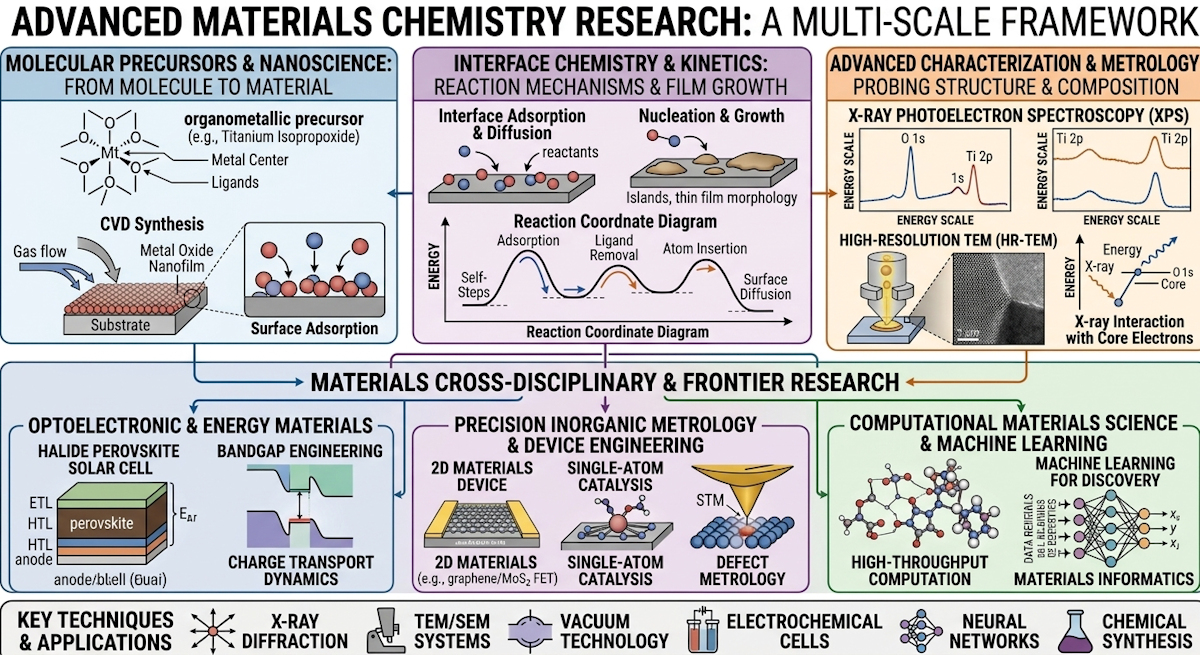
Materials Chemistry
Materials chemistry designs novel substances with tailored atomic structures to deliver targeted functional properties. Integrating AI, computational modeling, and green engineering accelerates material discovery for energy, electronics, and sustainability, transforming standard synthesis into a predictive, data-driven science.
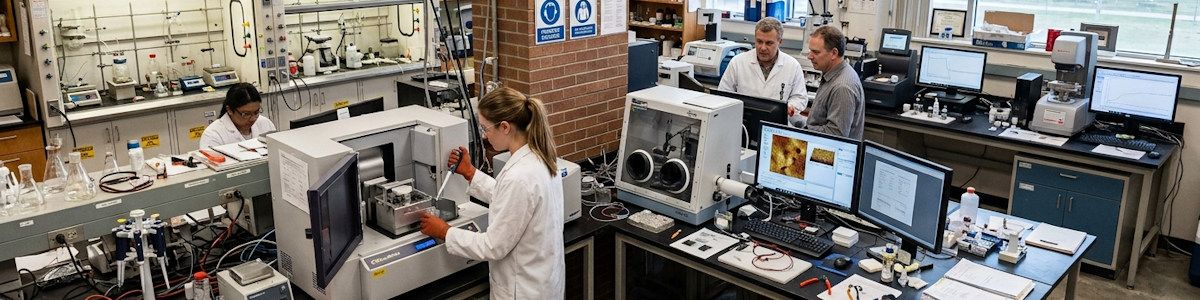
The George Gray Materials Chemistry Center
 Named in honor of George William Gray — the pioneering British chemist whose groundbreaking synthesis of liquid-crystalline cyanobiphenyls revolutionized soft-matter science and laid the technological bedrock for the modern electronic display industry — serves as the high-precision central hub for condensed matter and synthetic materials research at Analex Laboratories. The laboratory blends advanced molecular engineering with precision structural characterization, specialized in designing, synthesizing, and testing novel functional materials from responsive polymers up through advanced semiconductors and nano-composites.
Core Capabilities & Equipment
- Variable-Temperature Powder X-Ray Diffraction (PXRD): High-resolution diffractometers equipped with environmental stages track real-time phase transitions, crystalline lattice expansion, and structural self-assembly across extreme temperature and pressure ranges.
- Atomic Force & Scanning Tunneling Microscopy Suite: Ultra-sensitive scanning probe instruments resolve surface topographies, local electronic properties, and nanometer-scale morphology down to atomic dimensions for thin films and 2D materials.
- Differential Scanning Calorimetry & Thermal Gravimetric Analysis: Precision thermal analysis arrays measure glass transition temperatures, melting enthalpies, and thermal decomposition thresholds to evaluate the stability of advanced polymers and composite matrices.
- Rheology & Dynamic Mechanical Analysis Station: Automated mechanical testing equipment characterizes viscoelastic properties, flow behavior, and mechanical moduli of complex fluids, gels, and structural elastomers under controlled shear and tensile stress.
At Analex Laboratories, research and discovery in materials chemistry operate at the convergence of molecular design, physics, and advanced engineering. By targeting the fundamental relationships between atomic architecture and macro-scale functionality, the consortium focuses on synthesizing novel substances engineered for extreme efficiency, durability, and responsiveness. This effort moves beyond trial-and-error chemistry, replacing traditional empirical methods with high-throughput discovery workflows that allow researchers to manipulate matter with sub-nanometer precision.
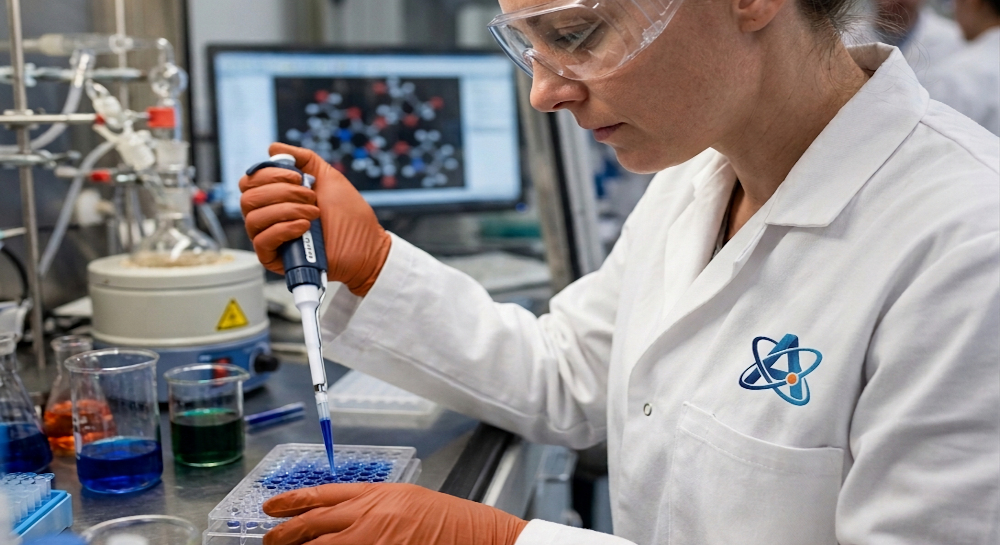
Central to Analex’s strategy is the integration of predictive artificial intelligence and quantum mechanical modeling into early-stage synthesis. Computational pipelines simulate millions of potential crystal lattices, covalent organic frameworks, and alloy compositions, evaluating their mechanical, electronic, and thermal properties before a single physical reaction is conducted. This digital-first approach significantly narrows the candidate pool, enabling lab scientists to prioritize candidates with optimal energy storage, catalytic activity, or structural resilience.
In the physical synthesis phase, Analex Laboratories leverages automated, robotic micro-fluidic platforms and advanced additive manufacturing techniques. These systems continuously adjust reaction variables—such as temperature, pressure, and precursor concentration—to rapidly fabricate high-purity, complex materials. Among the consortium’s key focal areas are self-healing polymers, solid-state electrolytes for next-generation energy storage, and biomimetic materials that dynamically adapt to environmental stress, opening new frontiers in aerospace, renewable energy, and medical diagnostics.
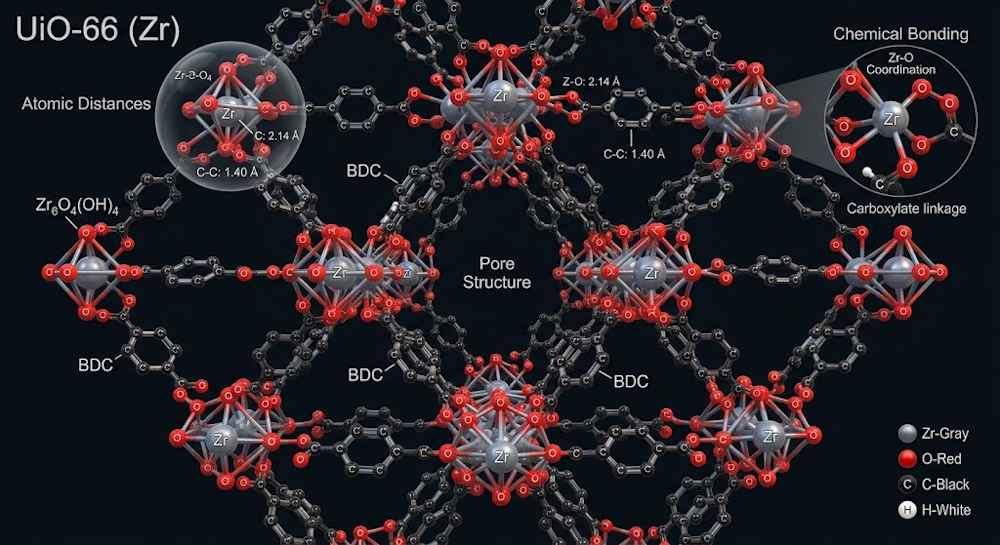
Characterization at Analex relies on state-of-the-art operando spectroscopy and high-resolution electron microscopy. By observing how synthesized materials behave in real time under operational conditions—such as extreme heat, corrosive chemical environments, or high voltage—researchers gather immediate feedback on structural degradation and phase transitions. This empirical data feeds back into the computational models, creating a closed-loop learning cycle that continually sharpens the precision of future material design.
Through this multi-disciplinary pipeline, Analex Laboratories is accelerating the transition of breakthrough compounds from theoretical concepts to scalable, industrial-grade solutions. By systematically bridging the gap between quantum-level physics and practical material applications, the consortium is establishing the foundational infrastructure for the next era of sustainable technology and advanced manufacturing.