Advanced Aerospace Manufacturing
Modern research, development, and engineering in Advanced Aerospace Manufacturing focuses on creating agile, sustainable, and precision-controlled production ecosystems capable of fabricating next-generation airframes, propulsion systems, and space structures with unprecedented geometric complexity and material efficiency. At the foundational layer, digital-thread architectures and physics-informed production models decouple traditional manufacturing constraints from design optimization, enabling the fabrication of topology-optimized structures, multi-material assemblies, and functionally graded components that were previously impossible to produce. These advanced manufacturing paradigms integrate additive processes, automated fiber placement, intelligent machining, and real-time quality assurance to deliver flight-critical hardware with reduced lead times, lower material waste, and enhanced performance characteristics across commercial aviation, defense platforms, and deep-space exploration systems.
Additive Manufacturing & Topology-Optimized Fabrication
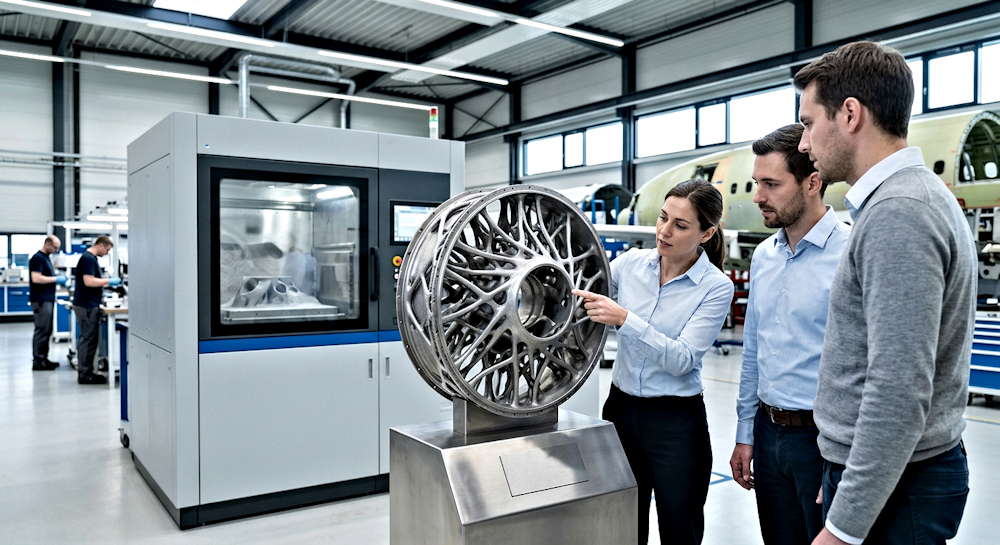
Modern aerospace production increasingly relies on metal additive manufacturing and polymer-based additive processes to fabricate complex geometries that exceed the capability of traditional subtractive machining or forming operations. By building components layer-by-layer directly from digital models, manufacturers eliminate tooling constraints, consolidate multi-part assemblies into single printed components, and realize organic, biomimetic structures optimized for specific load paths. At the core of this capability are high-precision powder-bed fusion systems, directed energy deposition platforms, and hybrid manufacturing cells that combine additive buildup with precision machining operations.
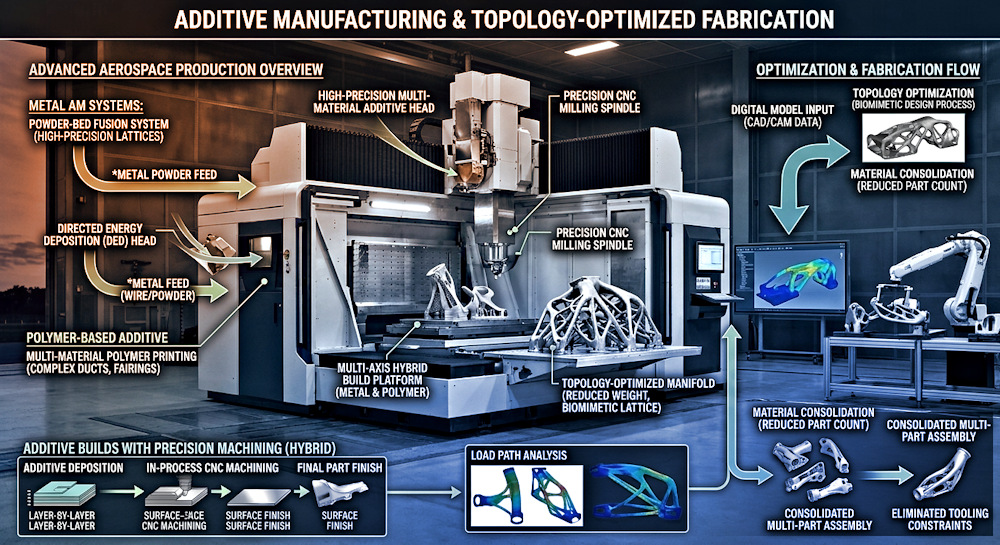
The shift toward Additive Manufacturing represents a fundamental transition from design-for-manufacturing constraints to manufacturing-for-design freedom, moving the industry away from geometric compromises imposed by traditional mills, lathes, and forming dies toward true topology-optimized, weight-efficient structures.
Key Technical Pillars
Topology Optimization & Generative Design
- Computational algorithms generate structural layouts optimized for specific load cases, boundary conditions, and mass minimization objectives
- Resulting geometries feature organic lattice structures, internal conformal cooling channels, and non-intuitive load paths impossible to machine conventionally
- Design automation tools integrate directly with additive process planning to ensure manufacturability of optimized geometries
Multi-Material Additive Fabrication
- Advanced deposition systems enable gradient transitions between dissimilar alloys or polymer matrices within single components
- Functionally graded materials match thermal expansion coefficients, wear resistance, and structural properties to specific locations within assemblies
- Embedded sensors and circuitry printed directly into structural components create smart, self-monitoring hardware
Hybrid Manufacturing Integration
- Combined additive-subtractive workcells deposit material where needed, then precision-machine critical surfaces to tight tolerances within single setups
- In-process metrology feedback loops adjust deposition parameters in real time to compensate for thermal distortion and residual stress accumulation
- Automated toolpath generation optimizes the transition between additive buildup and finish machining operations
Recent Innovations in Open Autonomy
High-Deposition-Rate Metal Printing
- Advanced laser and electron-beam systems achieve deposition rates orders of magnitude faster than legacy powder-bed technologies while maintaining metallurgical integrity
- Large-scale deposition systems fabricate meter-class structural components for airframes and propulsion housings without assembly joints
In-Situ Process Monitoring & Adaptive Control
- Multi-spectral imaging, pyrometry, and acoustic emission sensors monitor melt pool dynamics during deposition
- Machine learning algorithms detect anomalies such as keyholing, porosity formation, or lack-of-fusion defects in real time, automatically adjusting power density and scan strategies
Vacuum-Environment Additive Processing
- Electron-beam and laser systems operating in high-vacuum or inert-atmosphere chambers eliminate oxidation and contamination when processing reactive alloys
- Enables fabrication of high-performance titanium aluminides, nickel superalloys, and refractory metals for extreme-temperature applications
Strategic & Operational Advantages
- Supply Chain Resilience: Distributed additive manufacturing reduces dependency on complex global supply chains for specialized forgings and castings; digital part files enable on-demand production at forward locations
- Lead Time Compression: Elimination of hard tooling and fixturing reduces prototype development from months to days and production ramp-up from years to weeks
- Performance Optimization: Topology-optimized structures achieve weight reductions of 30-50% compared to traditional designs while maintaining or exceeding structural performance
- Assembly Consolidation: Multi-part assemblies consolidated into single printed components reduce fastener counts, joint interfaces, and potential failure points
Advanced Composite Materials & Automated Fiber Placement
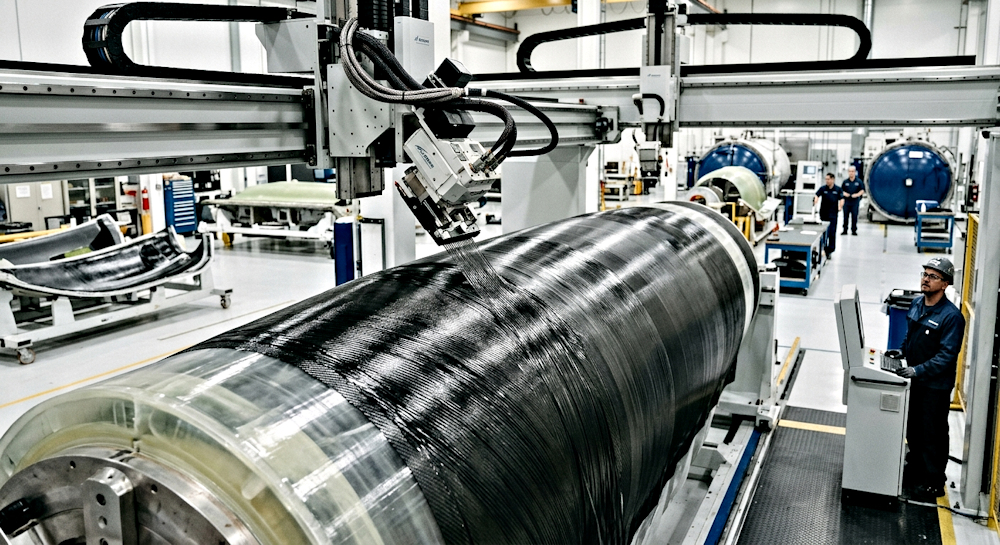
High-performance aerospace structures increasingly depend on carbon fiber reinforced polymers, ceramic matrix composites, and thermoplastic composites to achieve strength-to-weight ratios impossible with metallic alloys. Automated Fiber Placement (AFP) and Automated Tape Laying (ATL) systems precisely deposit pre-impregnated tows or dry fiber tapes onto complex mandrels and tooling surfaces, creating optimized laminates with tailored fiber orientations and ply schedules. These automated processes enable the fabrication of large, integrated composite structures such as wing skins, fuselage barrels, and propulsion casings with minimal void content, consistent fiber volume fractions, and optimized structural performance.
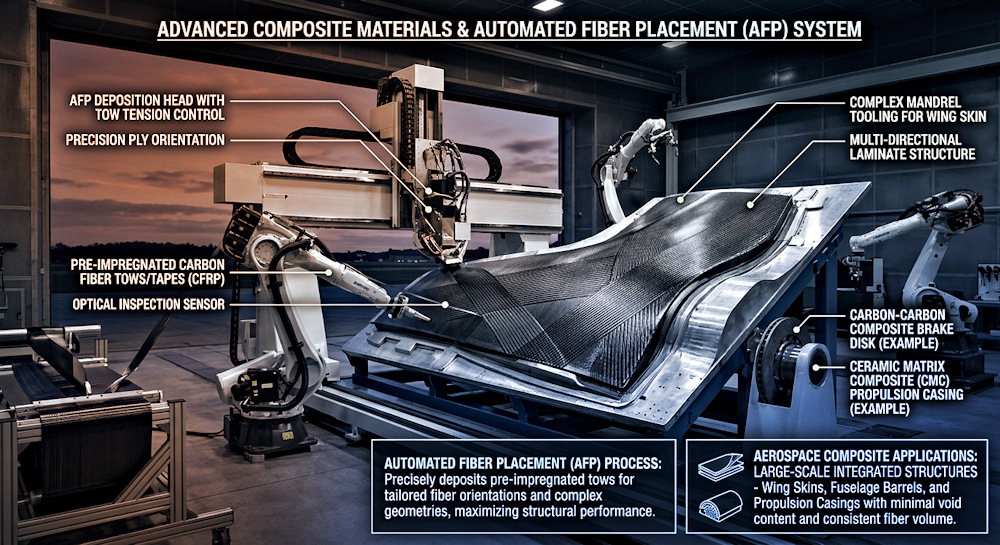
Advanced Composite Manufacturing represents the convergence of materials science, robotics, and computational modeling to produce damage-tolerant, corrosion-resistant structures that withstand extreme aerodynamic, thermal, and mechanical loads across operational lifetimes measured in decades.
Key Technical Pillars
Automated Fiber Placement Robotics
- Multi-axis robotic systems and gantry-mounted placement heads deposit composite tows with precise tension, steering, and compaction control
- In-situ consolidation via ultrasonic welding or laser-assisted heating enables thermoplastic composite processing without autoclave curing
- Steered fiber paths follow load trajectories, optimizing structural efficiency by aligning fibers with principal stress directions
Out-of-Autoclave Curing Systems
- Vacuum-bag-only and oven-cure resin formulations eliminate the size constraints and energy consumption of traditional autoclave processing
- Microwave-assisted curing and infrared heating systems accelerate cure cycles while maintaining resin glass transition temperatures and mechanical properties
- Self-heating tooling incorporates embedded heating elements that apply heat directly at the laminate interface
Ceramic Matrix Composite Fabrication
- Chemical vapor infiltration and polymer impregnation pyrolysis processes create silicon carbide fiber reinforced ceramic matrices for extreme-temperature applications
- Oxide-oxide composites provide high-temperature oxidation resistance for hypersonic leading edges and propulsion components
Recent Innovations
Dry Fiber Placement & Liquid Resin Infusion
- Automated placement of dry fiber preforms followed by resin transfer molding or vacuum-assisted resin infusion reduces material costs and enables very large structures
- Precision fiber steering algorithms prevent wrinkling and fiber distortion in complex double-curvature geometries
In-Situ Consolidation of Thermoplastics
- Laser- or ultrasonic-assisted AFP systems melt thermoplastic matrices during placement, eliminating separate autoclave or oven curing cycles
- Enables rapid processing speeds and welding of thermoplastic composite joints for assembly operations
Recyclable and Bio-Derived Resin Systems
- Thermoplastic resin systems enable end-of-life recycling and material recovery from retired aircraft structures
- Bio-derived epoxy formulations and natural fiber reinforcements reduce carbon footprint while meeting aerospace flammability and structural requirements
Strategic & Operational Advantages
- Structural Efficiency: Optimized fiber placement achieves specific strength and stiffness properties tailored to local loading conditions, reducing structural weight by 20-40% compared to aluminum designs
- Corrosion and Fatigue Resistance: Composite structures eliminate galvanic corrosion and demonstrate superior fatigue life compared to metallic alternatives
- Large-Scale Integration: Automated placement enables fabrication of full-barrel fuselage sections and continuous wing skins, reducing part counts and assembly labor
- Thermal Management: Ceramic matrix composites operate at temperatures exceeding 1,600°C, enabling uncooled hypersonic structures and high-efficiency turbine components
Digital Thread & Smart Manufacturing Architectures
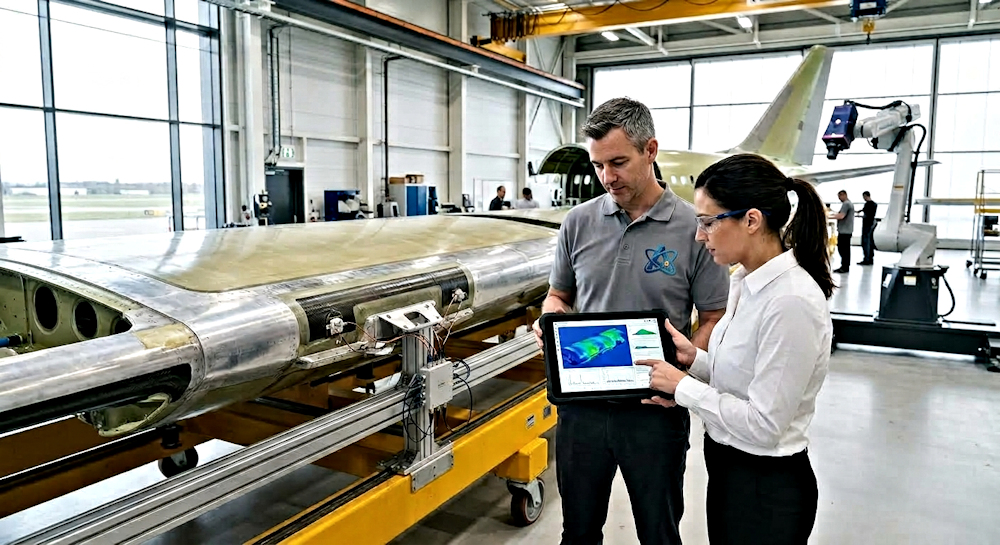
Modern aerospace manufacturing facilities implement comprehensive digital-thread frameworks that connect conceptual design, structural analysis, process planning, production execution, and quality verification within unified data environments. These smart manufacturing architectures leverage model-based definitions, physics-informed simulations, and real-time production analytics to optimize manufacturing processes, predict equipment maintenance requirements, and ensure dimensional conformance throughout complex fabrication sequences.
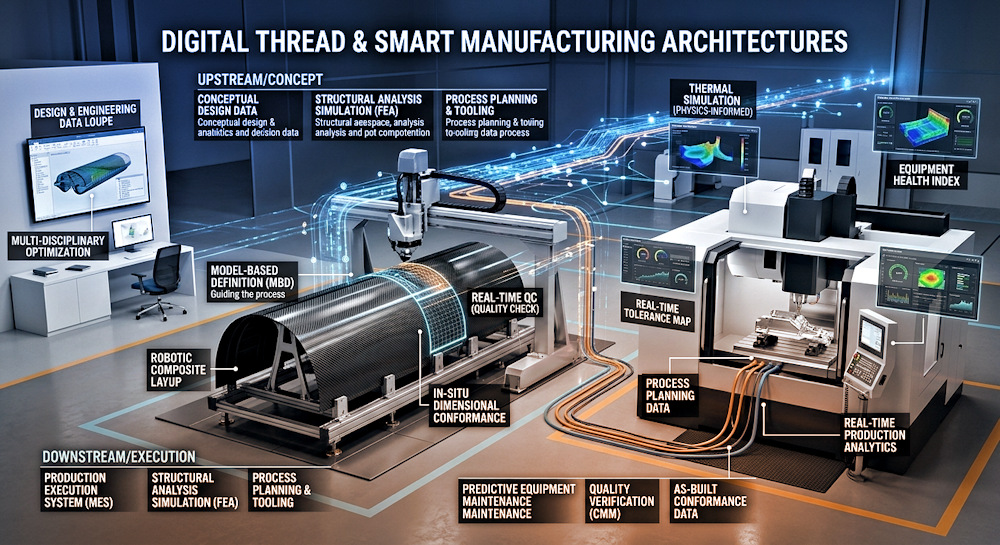
Digital Thread Integration represents the elimination of data silos between engineering and production, creating closed-loop systems where manufacturing data continuously informs design improvements and design intent directly drives automated fabrication without translation errors or information loss.
Key Technical Pillars
Model-Based Enterprise (MBE) Frameworks
- Three-dimensional CAD models serve as the authoritative source for geometric dimensions, tolerances, surface finishes, and material specifications
- Product manufacturing information embedded directly in digital models eliminates two-dimensional drawing interpretation errors
- Digital twins of manufacturing processes simulate production sequences to identify interference, thermal distortion, and tooling conflicts before physical fabrication
Industrial Internet of Things (IIoT) Integration
- Networked sensors on machine tools, robots, and auxiliary equipment stream operational data to centralized manufacturing execution systems
- Edge computing nodes process sensor data locally for real-time control decisions while feeding aggregate analytics to enterprise-level optimization algorithms
- Digital dashboards provide operators and engineers with real-time visibility into production status, quality metrics, and resource utilization
Artificial Intelligence-Driven Process Optimization
- Machine learning algorithms analyze historical production data to identify optimal cutting parameters, deposition strategies, and cure cycles
- Predictive maintenance models forecast equipment failures based on vibration, temperature, and power consumption signatures
- Automated scheduling systems dynamically adjust production sequences in response to material availability, equipment status, and priority changes
Recent Innovations
Closed-Loop Dimensional Control
- In-line metrology systems using laser tracking, structured light scanning, and photogrammetry capture as-built geometries during fabrication
- Automated compensation algorithms adjust downstream operations to account for thermal distortion, springback, and material variability
Blockchain-Enabled Supply Chain Verification
- Distributed ledger technology tracks material certifications, test reports, and processing history from raw material to flight hardware
- Immutable records ensure traceability and authenticity of critical components while preventing counterfeit material introduction
Cloud-Based Collaboration Platforms
- Secure, distributed manufacturing networks enable real-time collaboration between engineering teams, suppliers, and production facilities across global locations
- Digital thread continuity maintained across organizational boundaries while protecting intellectual property and export-controlled technical data
Strategic & Operational Advantages
- First-Article Success: Physics-informed simulations and digital twin validation reduce rework and scrap rates, achieving first-article acceptance on complex components
- Rapid Design Iteration: Direct digital transfer from design to production enables same-day design changes and immediate production implementation
- Predictive Quality Assurance: Real-time process monitoring identifies deviation trends before out-of-tolerance conditions occur, preventing defect generation rather than detecting it post-fabrication
- Lifecycle Data Integrity: Complete digital records of as-built configurations, material properties, and inspection results support decades-long maintenance, repair, and modification activities
Precision Machining & Cryogenic Processing
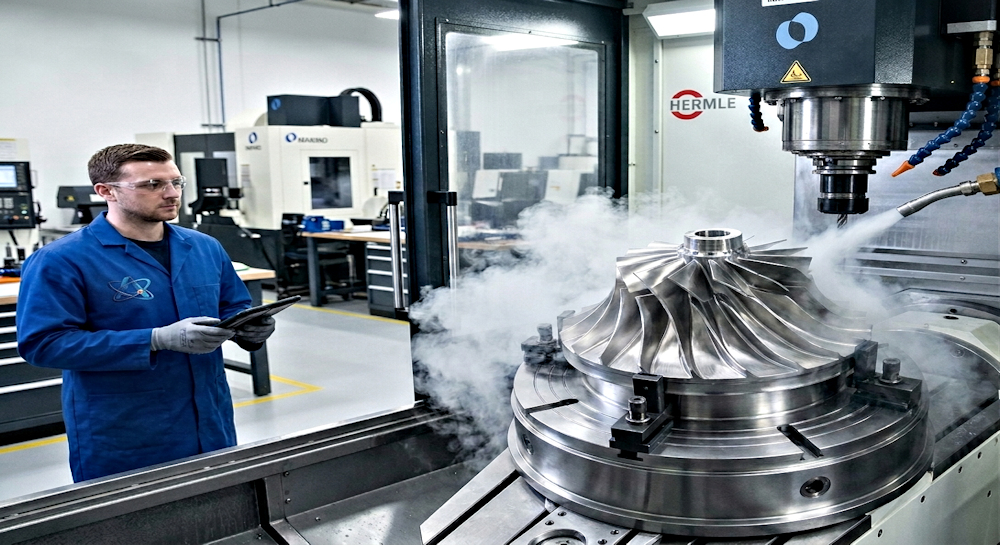
High-performance aerospace components demand extreme dimensional tolerances, surface integrity, and material properties achievable only through advanced precision machining and post-process conditioning. Cryogenic processing—exposing components to ultra-low temperatures using liquid nitrogen or cryogenic cooling systems—modifies material microstructures to enhance wear resistance, dimensional stability, and fatigue life. When combined with high-speed machining, hard turning, and precision grinding, these advanced manufacturing processes deliver critical rotating components, bearing surfaces, and structural interfaces with sub-micron accuracy.
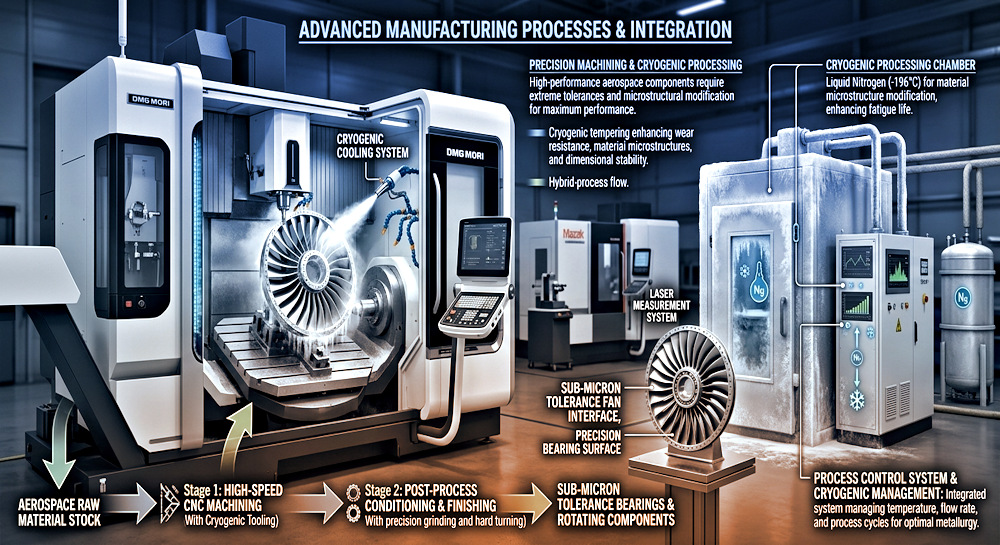
Precision Machining and Cryogenic Processing represent the intersection of mechanical engineering, materials science, and thermal physics to produce components that maintain critical fits, finishes, and mechanical properties across extreme operational environments and thermal cycling.
Key Technical Pillars
High-Speed and Hard Machining
- Spindle speeds exceeding 30,000 RPM and advanced cutting tool geometries machine hardened steels and nickel alloys without prior softening or annealing
- Through-tool cryogenic cooling delivers liquid nitrogen directly to cutting zones, eliminating thermal damage and extending tool life when machining difficult-to-cut materials
- Trochoidal and high-efficiency milling strategies optimize material removal rates while managing heat generation and tool loading
Cryogenic Treatment and Stabilization
- Controlled cooling to temperatures below -180°C modifies retained austenite in steels, precipitates eta-carbides in tool steels, and relieves residual stresses in aluminum alloys
- Deep cryogenic soaks followed by controlled tempering cycles improve wear resistance, reduce thermal expansion coefficients, and enhance dimensional stability
- Cryogenic deburring and deflashing use thermal contraction differentials to cleanly remove burrs from complex internal geometries
Ultra-Precision Finishing Operations
- Single-point diamond turning and deterministic micro-grinding achieve optical-grade surface finishes and form accuracies within nanometers
- Magnetic abrasive finishing and abrasive flow machining polish internal passages and complex geometries inaccessible to conventional cutting tools
Recent Innovations
Cryogenic Machining of Titanium and Composites
- External and internal cryogenic cooling systems prevent chemical adhesion between titanium chips and cutting tools, extending tool life by factors of 3-5
- Cryogenic cooling of carbon fiber composite machining prevents matrix softening and delamination damage while producing dust-free cutting environments
In-Process Metrology Integration
- On-machine probing and optical measurement systems verify dimensions without removing components from machining fixtures
- Automated compensation loops adjust final finishing passes based on in-process measurement feedback
Advanced Cutting Tool Coatings and Geometries
- Physical vapor deposition and chemical vapor deposition coatings provide extreme hardness, low friction coefficients, and thermal barrier properties
- Variable helix angles, chip-breaking geometries, and tailored edge preparations optimize cutting dynamics for specific aerospace alloys
Strategic & Operational Advantages
- Surface Integrity Assurance: Cryogenic processing and advanced machining produce compressive residual stress layers that improve fatigue resistance and crack initiation life
- Dimensional Stability: Cryogenically stabilized components resist thermal growth and creep deformation during high-temperature operation and thermal cycling
- Extended Component Life: Wear-resistant surfaces and stabilized microstructures extend service intervals for critical rotating machinery and actuation systems
- Process Efficiency: Hard machining eliminates separate heat treatment and grinding operations, reducing manufacturing flow time and work-in-process inventory
Sustainable Manufacturing & Circular Economy Approaches
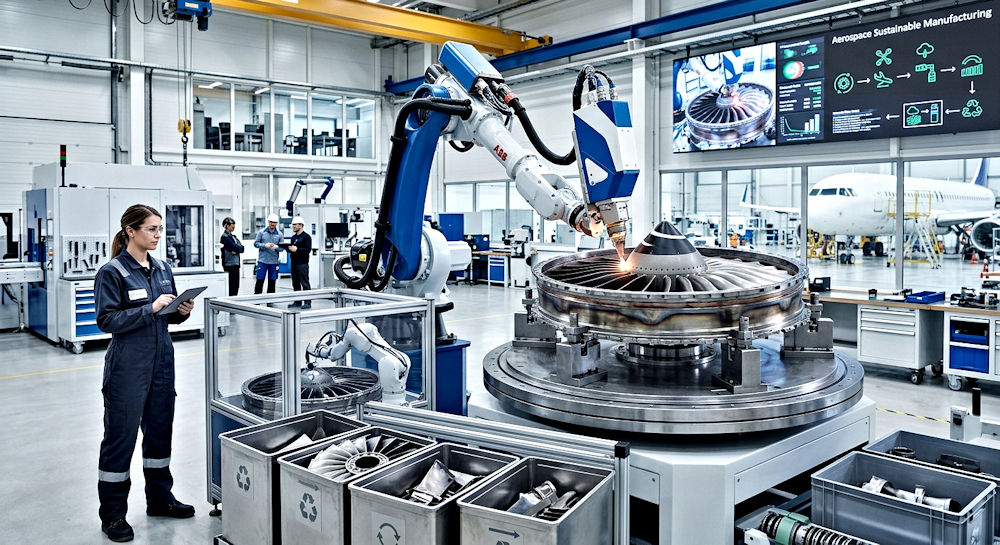
Environmental sustainability and resource efficiency increasingly drive aerospace manufacturing research and process development. Sustainable manufacturing initiatives focus on reducing energy consumption, eliminating hazardous materials, minimizing waste generation, and enabling end-of-life material recovery and reuse. Circular economy principles—designing for disassembly, material recycling, and remanufacturing—are being integrated into aerospace production planning to reduce the environmental footprint of airframe and engine manufacturing while ensuring long-term material availability.
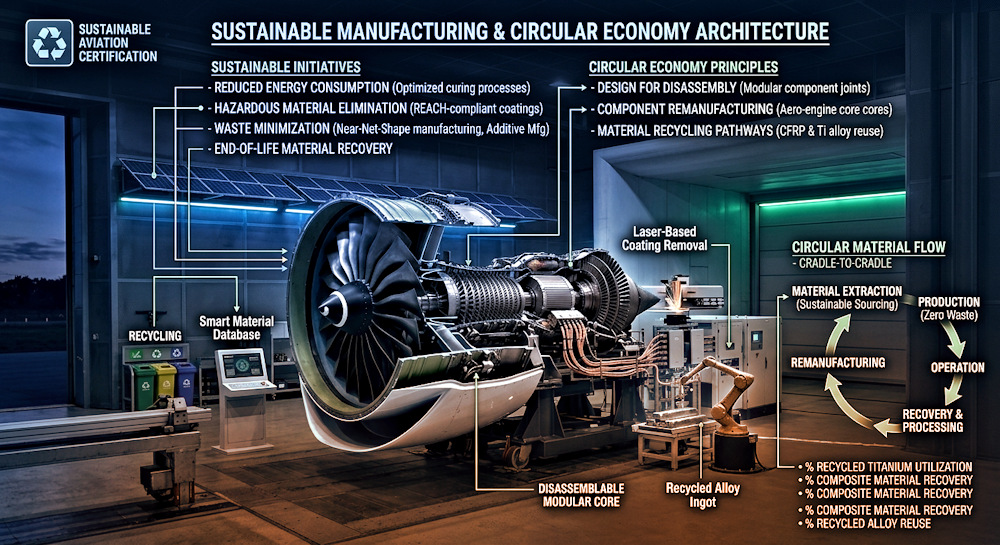
Sustainable Manufacturing represents a paradigm shift from linear "take-make-dispose" production models toward closed-loop systems where waste streams become feedstocks and manufacturing processes minimize environmental impact without compromising safety or performance.
Key Technical Pillars
Green Chemistry and Process Substitution
- Water-based cleaning systems and biodegradable cutting fluids replace chlorinated solvents and petroleum-based coolants
- Dry machining and minimum quantity lubrication eliminate liquid waste streams and reduce coolant system energy consumption
- Powder metallurgy and additive manufacturing reduce material waste compared to traditional subtractive approaches with scrap rates exceeding 70%
Energy-Efficient Processing
- Electromagnetic forming and friction-based welding processes reduce energy intensity compared to traditional fusion welding and thermal processing
- Waste heat recovery systems capture thermal energy from furnaces, ovens, and curing operations for facility heating or process pre-heating
- Renewable energy integration and on-site generation reduce carbon intensity of manufacturing operations
End-of-Life Material Recovery
- Design for disassembly protocols ensure components can be separated by material type at end of service life
- Supercritical fluid and chemical recycling processes recover carbon fibers from polymer matrices without mechanical damage
- Remanufacturing and refurbishment operations restore worn components to serviceable condition, extending material utility
Recent Innovations
Electrochemical Machining and Surface Treatment
- Electrochemical machining and electropolishing achieve precision material removal without mechanical cutting forces or tool wear
- Eliminates generation of metallic chips and grinding dust while producing superior surface finishes on complex geometries
Solid-State Join and Forming Processes
- Friction stir welding and linear friction welding join materials without melting, eliminating fumes, spatter, and solidification defects
- Electrically assisted forming reduces forming forces and enables processing of high-strength alloys at lower temperatures
Bio-Based and Recycled Material Integration
- Recycled carbon fiber and reclaimed aluminum alloys qualified for non-critical structural applications reduce virgin material demand
- Bio-derived resin systems and natural fiber composites demonstrate viability for interior components and secondary structures
Strategic & Operational Advantages
- Regulatory Compliance: Proactive adoption of sustainable practices ensures compliance with evolving environmental regulations and emissions standards
- Operational Cost Reduction: Energy efficiency, waste minimization, and material recovery reduce manufacturing operating costs and raw material expenditures
- Supply Chain Security: Material recycling and circular economy approaches reduce dependency on virgin material supply chains subject to geopolitical and market volatility
- Corporate Sustainability Goals: Demonstrable environmental stewardship supports customer and stakeholder sustainability commitments while attracting environmentally conscious workforce talent
Advanced Joining Techniques & Multi-Material Integration
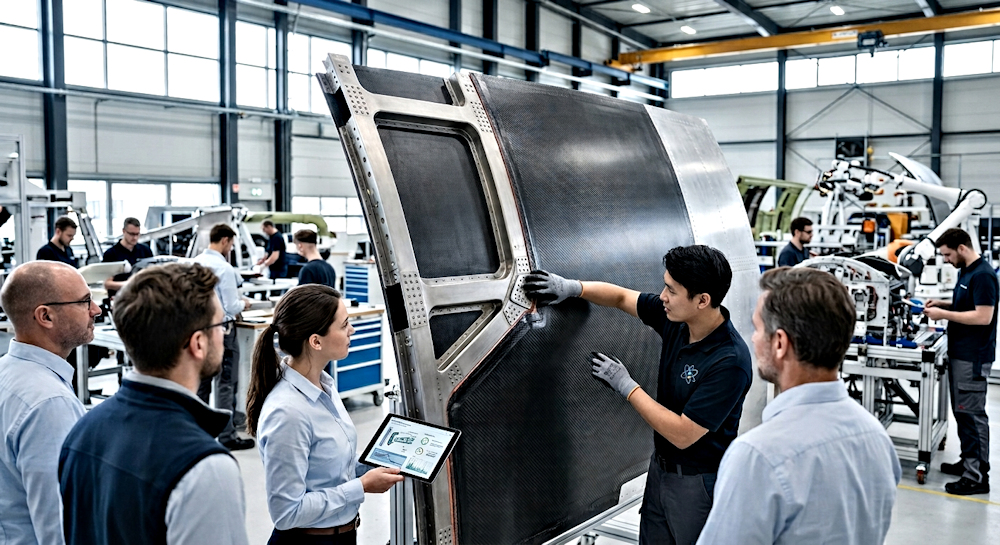
Modern aerospace structures increasingly combine dissimilar materials—metals, composites, ceramics, and advanced polymers—within single assemblies to optimize weight, cost, and performance across different operational zones. Advanced joining techniques enable robust, durable connections between these dissimilar materials while managing thermal expansion mismatches, galvanic corrosion potential, and load transfer requirements. Solid-state welding, adhesive bonding, and mechanical fastening innovations provide assembly solutions that maintain structural integrity across extreme temperature ranges, vibration environments, and fatigue loading conditions.
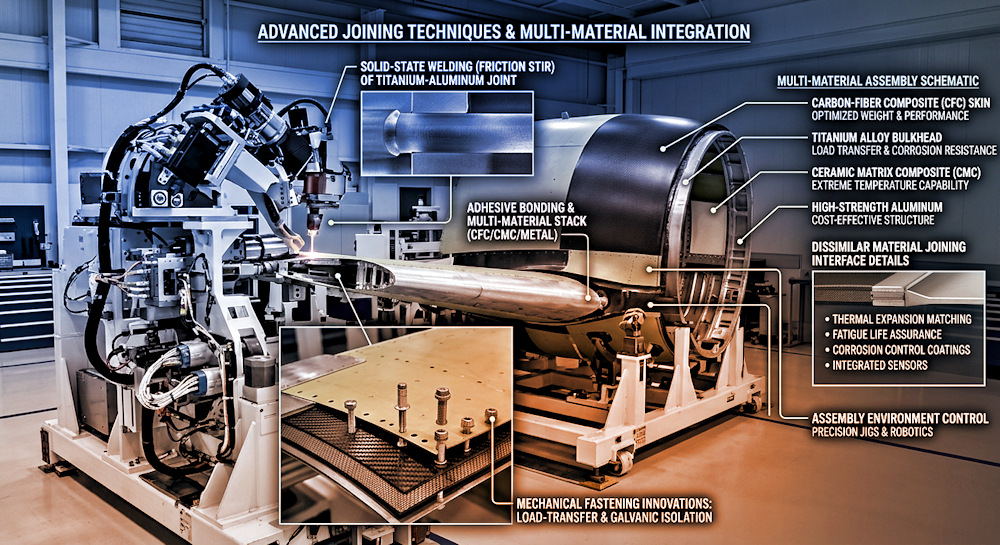
Advanced Joining and Multi-Material Integration represent the critical manufacturing capabilities enabling hybrid material structures that leverage the unique properties of each constituent material while ensuring durable, inspectable, and maintainable assemblies.
Key Technical Pillars
Solid-State Welding Processes
- Friction stir welding creates defect-free joints in aluminum, magnesium, and copper alloys without fusion-zone solidification cracking or porosity
- Linear friction welding joins bladed disks and compressor components in nickel superalloys and titanium with wrought-equivalent mechanical properties
- Explosion welding and magnetic pulse welding create metallurgical bonds between dissimilar metal combinations impossible to fusion weld
Structural Adhesive Bonding
- Toughened epoxy and bismaleimide adhesive systems provide structural load transfer between composite laminates and metallic fittings
- Surface preparation protocols including plasma treatment, sol-gel coatings, and peel-ply textures ensure durable adhesion and environmental resistance
- Film adhesives with controlled flow characteristics enable large-area bonding with consistent bondline thickness
Mechanical Joining and Fastening
- Self-piercing rivets and flow-drill screws create mechanical joints without pre-drilled holes, maintaining laminate integrity in composites
- Blind fastening systems install from single-side access, enabling assembly of closed sections and complex geometries
- Electromagnetic pulse joining and electromagnetic forming create mechanical interlocks with minimal heat-affected zones
Recent Innovations
Laser and Electron Beam Welding Advances
- Beam oscillation and wobble welding techniques control solidification microstructures and reduce residual stress in high-strength alloy welds
- Vacuum electron beam welding achieves deep penetration with minimal distortion in thick-section titanium and nickel components
Composite-to-Metal Hybrid Joints
- Co-curing metallic inserts into composite laminates during fabrication creates integrated attachment points
- Graduated material transitions using additive manufacturing bridge property mismatches between composites and metals
In-Process Weld Monitoring
- Optical and acoustic sensors monitor weld pool dynamics and solidification behavior in real time
- Machine learning classification of sensor data identifies defect formation and enables immediate process correction
Strategic & Operational Advantages
- Multi-Material Optimization: Hybrid structures place high-strength materials where loads concentrate and lightweight materials where weight reduction matters most
- Corrosion Management: Proper joining techniques isolate dissimilar metals to prevent galvanic corrosion while maintaining electrical grounding paths
- Assembly Efficiency: Advanced joining reduces fastener counts, sealant requirements, and assembly labor while improving structural continuity
- Damage Tolerance: Well-designed joints distribute loads to prevent stress concentrations and provide redundant load paths for damage tolerance