Analex Laboratories Flies Fault-Tolerant "AEROGRID" Powertrain: 12 Propulsors, 40-Millisecond Reconfiguration, 300-Foot Takeoff
STRATFORD Connecticut: Thuot Propulsion Systems Center
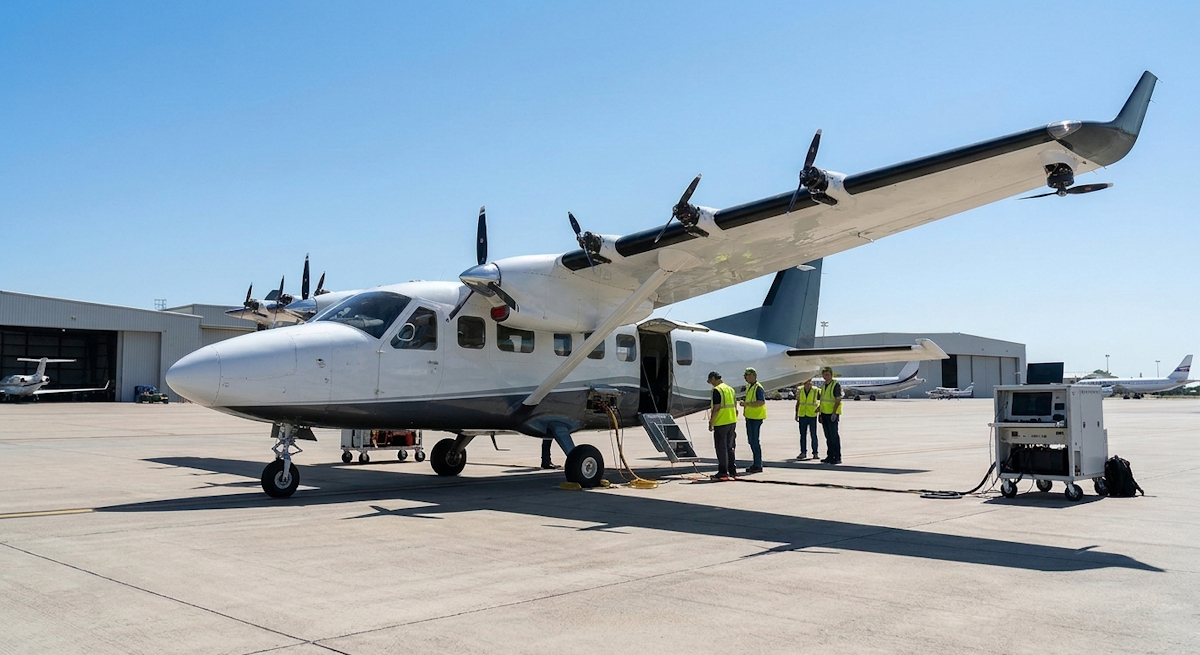
Analex Laboratories today reported the successful conclusion of a 19-month flight-test campaign for AEROGRID (Adaptive Electrified Reconfigurable Over-Wing Grid), a megawatt-class hybrid-electric propulsion architecture in which every propulsor is independently controlled, individually isolated and dynamically re-taskable in flight. Flying a modified nine-seat high-wing demonstrator designated AL-9 Heron, Analex completed 118 flights and 192 flight hours, including 46 deliberate in-flight fault injections that severed individual motor phases, tripped inverter strings and disconnected battery modules at cruise. In every case the grid reallocated thrust and re-trimmed the aircraft within 40 milliseconds, with a maximum transient of 1.4 degrees of bank and no pilot input required. The campaign also logged a 312-foot ground roll on takeoff — roughly a 40% reduction against the same airframe on turbine power alone — and a 22% reduction in block energy on a 240-nautical-mile representative mission.
The architecture is deliberately built around three ideas the field has struggled to combine. First, the grid is a DC microgrid: a 1.2 MW turbogenerator feeds an 800-volt bus alongside a 420 kWh liquid-cooled pack, with silicon-carbide inverters running at 99.2% efficiency and 20 kW/kg, and three independent redundant strings so that no single electrical fault can cost more than a third of installed thrust. Second, the propulsors are the flight controls. Nine small units along the leading edge provide blown lift and differential thrust for roll and yaw; two wingtip units act as drag-reduction devices and thrust vectoring surfaces; a single aft fan ingests the fuselage boundary layer. There are no ailerons and no rudder — control is entirely aero-propulsive, scheduled by a flight-control law that treats thrust as a primary effector. Third, the atmosphere is part of the loop: phase-synchronised rotor scheduling scatters blade-passage tones into broadband, with a measured 7.1 dB(A) reduction in the blade-passage tone at the lateral certification microphone position and a 31% reduction in the 55 dB(A) ground contour area versus the baseline turboprop. "The industry has spent a decade proving that electric propulsion can make an aircraft fly," said Dr. Ananya Patel, Chief Director of Aerospace Technology & Engineering at Analex Laboratories. "The harder question is whether it can make an aircraft safer than the turbine it replaces. AEROGRID's answer is that the grid is a safety feature before it is an efficiency feature: twelve small propulsors that can each cover for a neighbour beat two big ones that cannot cover for each other. We stopped treating distribution as a way to spend weight on redundancy and started treating it as the redundancy."
Analex was equally direct about what did not work. The aft boundary-layer-ingesting fan, which contributes the single largest efficiency gain in the design, proved acutely sensitive to inflow distortion: at high angles of attack the fan's first-stage blades saw a separated, unsteady wake that drove both a 2.6% thrust oscillation and a fatigue life penalty the team could not engineer away within the campaign. The programme's answer was a compliant, variable-camber fan blade with a shape-memory-alloy root, flown on the last 22 sorties, which cut the oscillation to 0.7% at a cost of 9 kg and 1.8% of fan efficiency. The company says the trade is favourable and is releasing the inflow-distortion dataset, along with its hardware-in-the-loop fault library of more than 4,000 simulated failure cases, to the wider research community — an explicit nod to the X-57 programme's decision to publish its own lessons after its cancellation. "X-57's cruise-motor problems and X-57's data are the reason AEROGRID's fault library exists in the form it does," Patel said. "The cheapest thing in this industry is somebody else's mistake."
The timing is pointed. In July, GE Aerospace and NASA flew a megawatt-class hybrid-electric system above 30,000 feet for the first time, and Electra's nine-seat blown-lift eSTOL is marching toward first flight behind roughly $9 billion in pre-orders. Analex says AEROGRID is airframe-agnostic and is being positioned as an integration layer rather than an aircraft, with a licensing model aimed at regional airframers and at the retrofit market, where a single electric propulsor can be swapped into an existing four-engine turboprop. The company is submitting its fault-isolation and thermal-containment test data to both the FAA and EASA, and says it has built the campaign specifically to answer the questions that Special Condition SC E-19 and the GAO's May 2026 finding — that the FAA is evaluating electric aircraft case by case and has certified no manned electric aircraft for commercial service — leave open: what happens after a thermal event, what the crew sees, and how a propulsion system fails when it fails electrically rather than mechanically. A 30-seat scaled derivative of the grid is planned for 2029, with a full certification-grade test article targeted for 2031.