Analex Laboratories Closes the Loop: "CASCADE" System Holds Quiet-Supersonic Signature at 68 PLdB Through Real Turbulent Air
STRATFORD Connecticut: Thuot Propulsion Systems Center
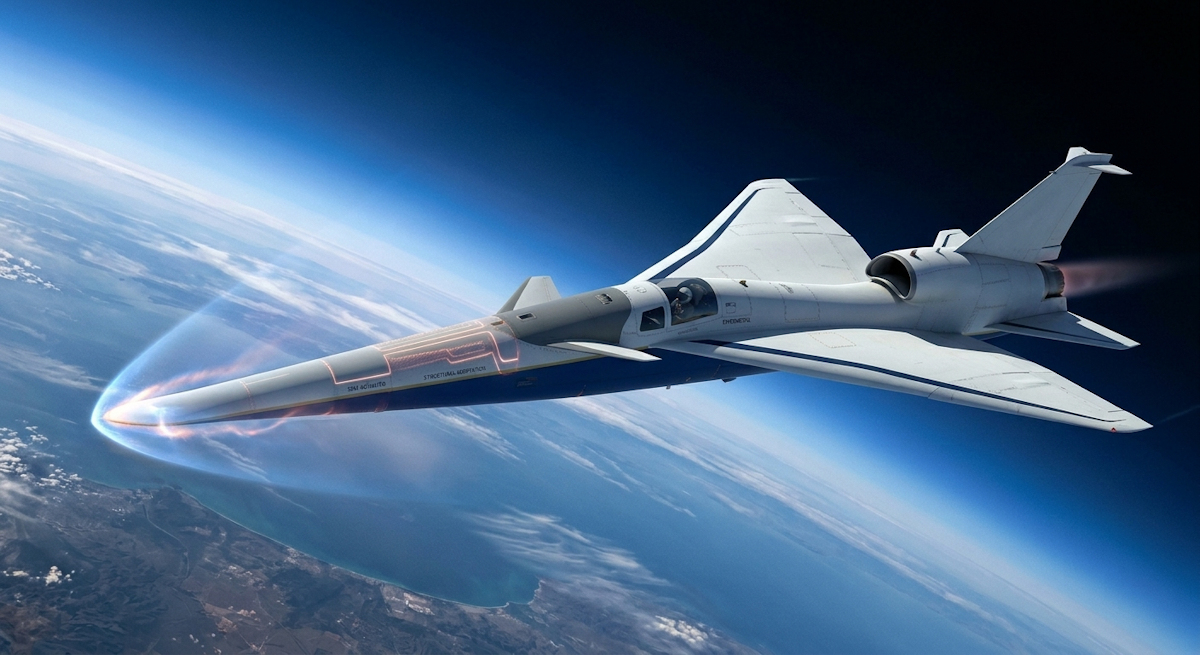
Analex Laboratories announced today that its Aerospace Technology & Engineering directorate has completed a 14-month ground, wind-tunnel and flight-test campaign for CASCADE (Closed-loop Adaptive Signature Control and Atmospheric Dispersion Engineering), an integrated boom-suppression architecture that, for the first time, actively holds a shaped sonic signature at a target loudness rather than merely achieving it at a single design point. Across 41 supersonic test runs flown by a modified two-seat demonstrator over the mid-Atlantic supersonic corridor, CASCADE held ground-perceived loudness between 66 and 68 PLdB in standard atmosphere — and, critically, between 67 and 71 PLdB in the turbulent, non-standard conditions that have historically thrown low-boom designs a full 10 dB off target. Nine runs, flown at the atmospheric refraction limit, produced no measurable boom on the ground at all, with surface overpressure never exceeding 0.04 psf — comfortably inside the FAA-proposed 0.11 psf ceiling.
The system works by attacking the signature problem from three directions at once. Forward-looking LIDAR on the nose maps temperature, wind shear and turbulence intensity ahead of the aircraft in real time; Analex's in-house propagation solver, which ingests the same wavefront measurements that underpin the PCBoom and sBOOM toolchains, predicts the ground signature the aircraft is about to make and solves for the correction. Compliant shape-memory-alloy actuated panels along the forward fuselage and aft body then deform the effective area distribution — spreading the front shock's pressure rise into a controlled ramp and softening the rear closure — while a ring of plasma energy-deposition electrodes just ahead of the bow shock ionizes and pre-heats the incoming flow, thickening the front shock foot and shaving its peak overpressure. The loop closes at 40 Hz, far faster than the aircraft can traverse a turbulent eddy of meaningful size. "For sixty years we have designed low-boom aircraft on paper against a standard atmosphere and then hoped the real sky cooperated," said Dr. Ananya Patel, Chief Director of Aerospace Technology & Engineering at Analex Laboratories. "CASCADE stops hoping. We are no longer asking what boom this airframe makes; we are telling the atmosphere what boom it is allowed to deliver. A shaped signature that survives turbulence is the difference between a laboratory demonstration and an aircraft an airline can actually schedule."
The campaign's most closely watched results were its off-design runs. Analex deliberately flew the demonstrator outside its shaped envelope — at Mach 1.18 through 1.55, at altitudes from 41,000 to 58,000 feet, and through a documented frontal passage with 18-knot wind shear — and recorded ground signatures using a 22-microphone linear array, a ground-based sailplane-mounted probe and two free-flying instrumented motorgliders positioned at the carpet edge. CASCADE's signature-hold performance degraded by no more than 4 PLdB in the worst case, a figure Patel's team attributes to actuator bandwidth rather than to any propagation-model error. Analex is releasing the unprocessed array recordings and the associated atmospheric soundings to the research community. Analex has also flagged the secondary-boom case, the indirect far-field signatures that sank Concorde's reputation in New England in the 1970s, as a place where its atmospheric refraction logic offers an unplanned benefit: the same real-time solver that keeps the primary boom quiet is being used to steer away from the focusing conditions that generate secondary booms.
Analex says the architecture is airframe-agnostic and is now being offered for integration studies to supersonic transport, business-jet and unmanned-boomer programs on three continents, with a scaling plan aimed at a full-size demonstration article by 2029 — timing that would land just as the FAA's interim en route certification standard is finalized and roughly two years ahead of the ICAO international low-boom standard expected around 2031. The company is candid that CASCADE does not repeal the drag and weight penalties of low-boom shaping, and that its plasma system imposes a measurable power draw at cruise. "The honest framing is that we have converted an aerodynamic problem into a control problem," Patel added. "That is a trade we will take every single time, because control problems get better with software and sensors, and aerodynamics does not."