Analex Laboratories Demonstrates 99.4% Water Loop Closure in 180-Day Integrated Habitat Trial
LAKEWOOD Colorado: Swigert Environmental Control & Life Support Systems Center
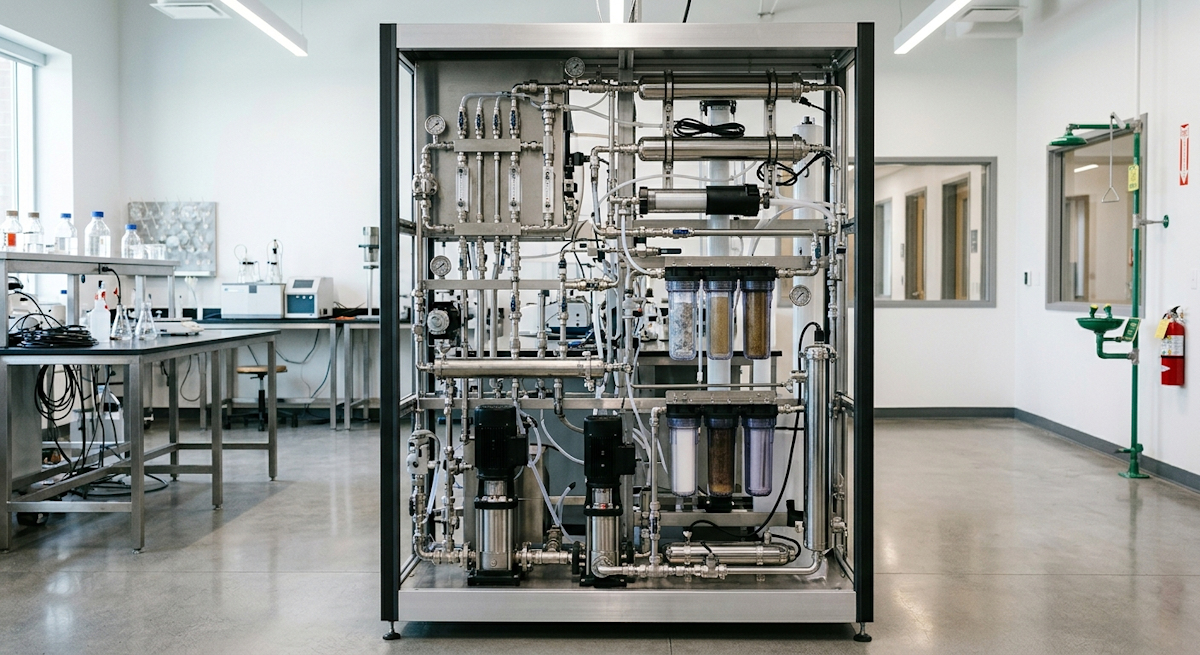
Analex Laboratories today announced that its Cascaded Brine Valorization (CBV) architecture has sustained 99.4% total water loop closure across a continuous 180-day integrated test at six-crew equivalent loading, the highest verified closure rate reported to date for a regenerative life support water train and a decisive step beyond the 98% threshold NASA has identified as the gate for crewed Mars transit. The trial ran three full-stack iterations of the Analex water train — urine stabilization, vacuum distillation, pervaporative brine polishing, catalytic oxidation and iodinated storage — against a simulated deep-space consumable budget with no brine bladder discards and no membrane replacements for the duration of the run.
The architecture's central innovation is a two-stage brine cascade that replaces single-pass membrane distillation. Stage one uses a pulsed-field electrodialysis cell to strip residual ammonium and monovalent salts from distillation brine, suppressing the osmotic back-pressure that normally chokes pervaporation at high concentration. Stage two passes the partially demineralized brine across a self-regenerating ionomer–microporous membrane pair where water vapor transfers into a closed recirculating dry-air sweep, which is then condensed and routed back to the purification train. The salts removed in stage one are mineralized into recoverable ammonium bicarbonate and sodium chloride solids rather than being sealed into a discard bladder — the single largest mass penalty in the current ISS baseline. Across the trial, the CBV stack returned 1,041 liters of previously unrecoverable water from brine while cutting brine-related consumable mass by 63% relative to the published baseline.
"This is not a refinement of distillation, it is the end of distillation as the terminal step," said Dr. Ananya Patel, Chief Director of Aerospace Technology & Engineering at Analex Laboratories. "For forty years the industry has treated that last two percent as a rounding error when you simply launch from Earth. It isn't. On a 1,000-day Mars transit, two percent of a six-crew water budget is the difference between a mission that resupplies and a mission that closes. Our cascade takes the brine — the dead end of every distillation loop ever flown — and makes it a water source with a solids byproduct instead of a waste stream."
Validation data from the trial showed 99.4% ± 0.3% closure sustained across all three stack iterations, with membrane flux degradation held under 4% over 180 days and zero catalytic reactor change-outs. Water produced met or exceeded NASA potability specifications on all 214 sampling events, including total organic carbon, conductivity and microbial limits, with the iodine biocide residual tracking inside the potable bus window throughout. A parallel terrestrial configuration of the same cascade, tested against a brackish groundwater feed, achieved 97.8% recovery at 41% lower specific energy than a comparable reverse osmosis and thermal brine concentrator train, positioning the technology for remote and arid deployment where brine disposal is the binding constraint.
Analex Laboratories said the CBV stack will be packaged as a rack-replaceable assembly for a 2028 subscale flight demonstration, with a full-duration 500-day integrated trial planned to characterize solids accumulation, sensor drift and long-life consumable margins before a transit-class qualification campaign. The consortium is publishing its full test dataset, membrane characterization protocols and failure-mode analyses as an open reference set, and has invited partner institutions to submit independent replication runs against the same 180-day test matrix.