Analex Laboratories' "KEYSTONE" Cuts Backplane Integration from 14 Months to 9 Weeks and Caught 41 Legal-but-Incompatible Modules
TUCSON Arizona: Creamer Avionics Center
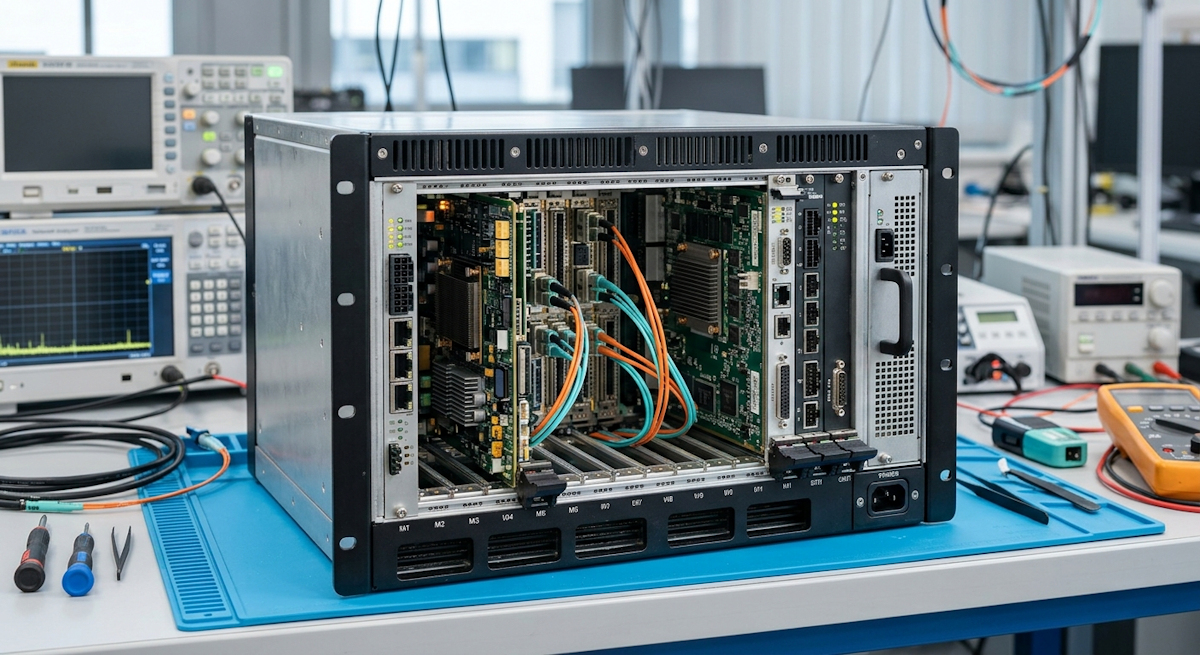
Analex Laboratories today announced that its Project KEYSTONE programme has completed an 18-month verification campaign establishing that the interoperability failure mode at the heart of open-architecture avionics is mechanically detectable before hardware integration, not after. Against a 380-case injected-deviation suite built from real VITA 65, SOSA and VITA 90 profile tables, KEYSTONE's conformance engine identified 100% of deliberately introduced profile violations — and, more significantly, flagged 41 cases that were fully standards-compliant on paper yet provably incompatible in a chassis, the class of failure that makes open standards frustrating in practice and that no profile table can express. In a parallel integration trial, a seven-slot OpenVPX payload set that had taken a partner organisation 14 months to bring to first power was brought up in nine weeks using KEYSTONE's generated test plan, with the engine catching two pin-level and three fabric-timing mismatches during bench assembly rather than at system test.
The architecture rests on three components. PROFILE is a machine-readable conformance and interoperability suite: it ingests published profile tables, generates an executable hardware-in-the-loop test plan, and then runs it on a representative chassis, producing evidence an integrator can hand to a customer rather than an assurance that a datasheet was read carefully. AXIOM is a 224-gigabit-per-lane optical fabric with an explicitly bounded latency envelope, built on blind-mating MT ferrules that held insertion loss below 0.6 dB across 500 mate cycles — and it exists so that a module can be swapped in place, inheriting the chassis's existing qualification because both the fabric's timing bound and the module's profile conformance are machine-verified on insertion. INTERFERENCE LEDGER automates the multi-core problem: it enumerates interference channels, produces the bound evidence required by AMC 20-193 and CAST-32A, and records which partitions may legally share which resources. "Open standards are a legal instrument, not a technical one," said Dr. Ananya Patel, Chief Director of Aerospace Technology & Engineering at Analex Laboratories. "A profile table tells you what a pin is permitted to be. It does not tell you what a system will do, and NASA's own SpaceVPX assessment said so in plain language — the flexibility is so great that interoperability cannot be assured. Everyone in this industry has been treating that as a reason to be careful. We treated it as a test problem. If a failure is detectable on a bench in nine weeks, then the standard's flexibility stops being a liability and starts being the thing you actually paid for."
Analex was candid about the limits. PROFILE cannot check what the standards do not state, so the legal-but-incompatible gap is narrowed rather than closed — the engine's detection rate on that class depends entirely on how thoroughly a given profile has been modelled, and coverage is uneven across the VITA catalogue. The suite is also a treadmill: every standards revision invalidates test assets, and the team has committed to a re-baselining cadence it concedes is expensive and unglamorous. AXIOM's determinism guarantee costs roughly 14% of usable bandwidth against a best-effort fabric, a trade Analex calls correct for a certifiable system and wrong for a throughput-first one. Most pointedly, the company notes that a conformance suite nobody submits to is a hobby: module-level qualification still requires an authority to accept a test report as evidence, and vendor participation is a business problem before it is a technical one.
The timing lands on a policy wave that is already legislated. MOSA has been mandatory for major defence acquisition programmes since 10 U.S.C. §4401, and NDAA §804 reinforced it — yet the GAO found in 2025 that programmes routinely failed to plan how they would verify MOSA before hitting production milestones. In the same period VITA and ANSI ratified VITA 90 VNX+ in February 2026, ratified ANSI/VITA 78.0-2026 SpaceVPX, and IEEE and SAE advanced P802.1DP / AS6675 as the aerospace TSN profile, while co-packaged optics at OFC 2026 pushed per-lane optical rates to 400 Gb/s. Analex says KEYSTONE is a verification product rather than a hardware product, and is positioning it for both defence integrators who must demonstrate MOSA compliance and civil airframers moving IMA payloads onto multi-core silicon under AMC 20-193. "The GAO finding is not that MOSA is bad," Patel added. "It is that nobody scheduled the verification. Keying a module is the easy part — the hard part is having a defensible answer when someone asks whether the new card is actually compatible, and whether you knew that before the aircraft went to ground test. That answer has to be evidence, and evidence has to be generated by something that is not a human being reading a datasheet at two in the morning." A certification-grade release of PROFILE and AXIOM is targeted for 2028, with INTERFERENCE LEDGER evidence packages being submitted alongside to the FAA and EASA as candidate AMC 20-193 inputs.