Analex Laboratories Consortium Demonstrates First Certified-Path Edge VLA Autonomy Stack Capable of Sustained 12 Hz Closed-Loop Flight
FARGO North Dakota: Buchli Autonomous Aerospace Systems Center
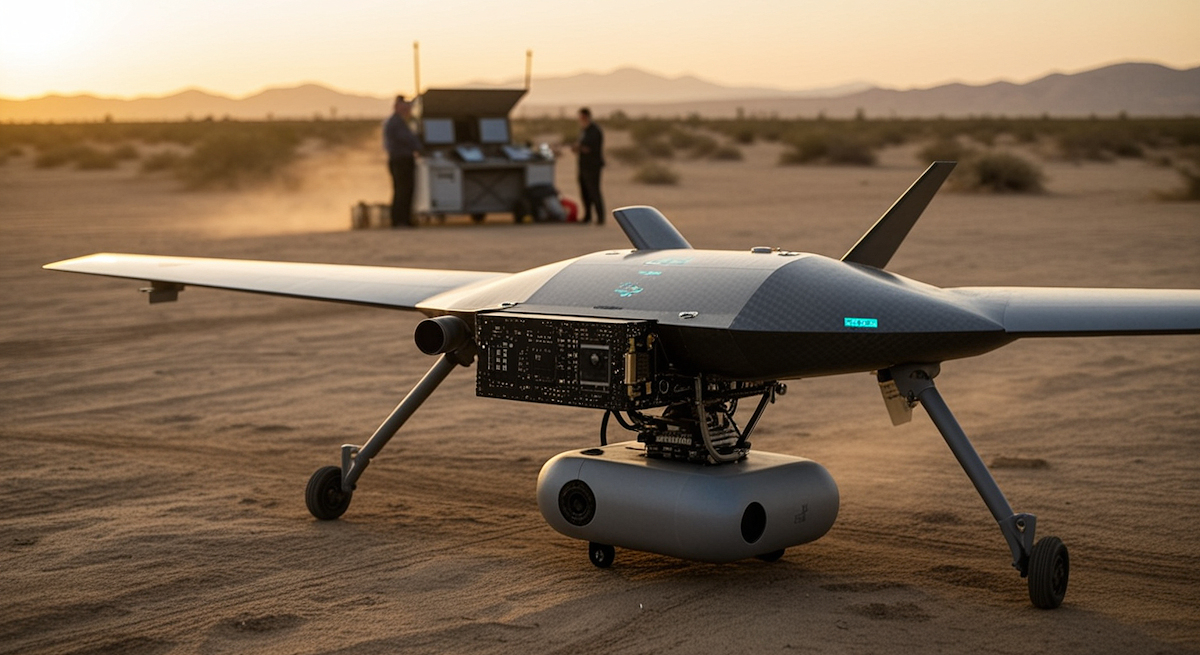
Analex Laboratories, together with a five-nation research consortium spanning twelve academic and industrial partners, today announced the successful completion of Project HELMSMAN, a 34-month program that produced the first end-to-end Vision-Language-Action autonomy stack designed from the ground up for airborne edge deployment under a DO-178C-aligned design assurance pathway. Across 1,140 logged flight hours on three unmanned platforms — a 24 kg quadrotor, a 90 kg tail-sitter, and a fixed-wing survey aircraft — the HELMSMAN stack executed high-level natural-language mission commands such as "survey the northern ridge and hold station over the substation" with a 94.3 percent task-completion rate and zero loss-of-control events. Critically, all perception, reasoning, and action generation ran onboard: no ground link, no cloud dependency, no operator in the loop.
The technical core of HELMSMAN is a deliberately asymmetric dual-system architecture. A 1.7-billion-parameter distilled vision-language backbone, quantized to 4-bit weights with channel-wise sensitivity-aware calibration, runs at 3 Hz to interpret scene semantics, parse intent, and emit hierarchical sub-goals. Those sub-goals stream into a 210-million-parameter flow-matching action expert that generates 1.2-second action chunks at 12 Hz, with an asynchronous execution pipeline that overlaps chunk generation against the currently executing trajectory to eliminate inter-chunk stall. Total end-to-end inference latency, measured at the actuator command boundary, averaged 71 ms — a roughly fourfold improvement over the consortium's own 2024 baseline and well inside the control loop's stability margin. The stack fits in 6.8 GB of unified memory on a 60 W embedded module, leaving headroom for a secondary safety monitor running a hand-tuned model-based controller as a runtime guardian.
"Everyone in this field spent three years chasing benchmark success rates on tabletop manipulation, and the aerospace community quietly kept asking the only question that matters: what happens when the model is wrong at 400 feet," said Dr. Evelyn Mercer, Senior Director of the Buchli Autonomous Aerospace Systems Center. "Our answer was to stop treating the learned policy as the sole authority. HELMSMAN runs a latent world model in parallel with the action expert; it rolls the next 800 milliseconds forward, compares predicted latent state against observed state, and hands control to a deterministic controller when the divergence exceeds a calibrated threshold. That is what let us fly 1,140 hours without a single loss-of-control event. The VLA does the thinking. The world model does the doubting. That combination is the actual breakthrough — not the parameter count."
The second pillar of Project HELMSMAN is what the consortium calls a Connected Fleet Reasoning Mesh. Rather than running a large model on every airframe, HELMSMAN nodes form an ad hoc mesh in which a single designated node hosts the full reasoning backbone while peer nodes offload perception tokens and contribute partial KV-cache segments over a bandwidth-adaptive link — an approach adapted from distributed-inference work in the UAV swarm literature and hardened for intermittent connectivity. When the mesh partitions, each node degrades gracefully to its local distilled policy within 140 ms and rejoins seamlessly on reconnection. Across the program, the mesh reduced aggregate per-aircraft compute demand by 61 percent while increasing fleet-level task throughput by a factor of 2.4 on multi-vehicle missions.
"What surprises people is that the hard part was never the model — it was the assurance story," said Dr. Ananya Patel, Chief Director of the Aerospace Technology & Engineering department at Analex. "We instrumented every learned component with traceable, testable interfaces so that the VLA occupies a bounded, verifiable slot in an otherwise conventional architecture. The action expert's outputs are rate-limited and range-checked against envelope constraints; the world-model divergence signal is a monitorable quantity with a defined failure mode; and the whole chain produces the requirement-level traceability artifacts DO-178C reviewers expect to see. We are not asking a certification authority to bless a black box. We are asking them to bless a well-characterized box that happens to contain a transformer. That reframing is worth more than any single benchmark number we produced."