Analex Laboratories Flies "ARGUS" Runtime Assurance Layer: 34-Millisecond Handover, 400 Flights, Zero Unsafe States
FARGO North Dakota: Buchli Autonomous Aerospace Systems Center
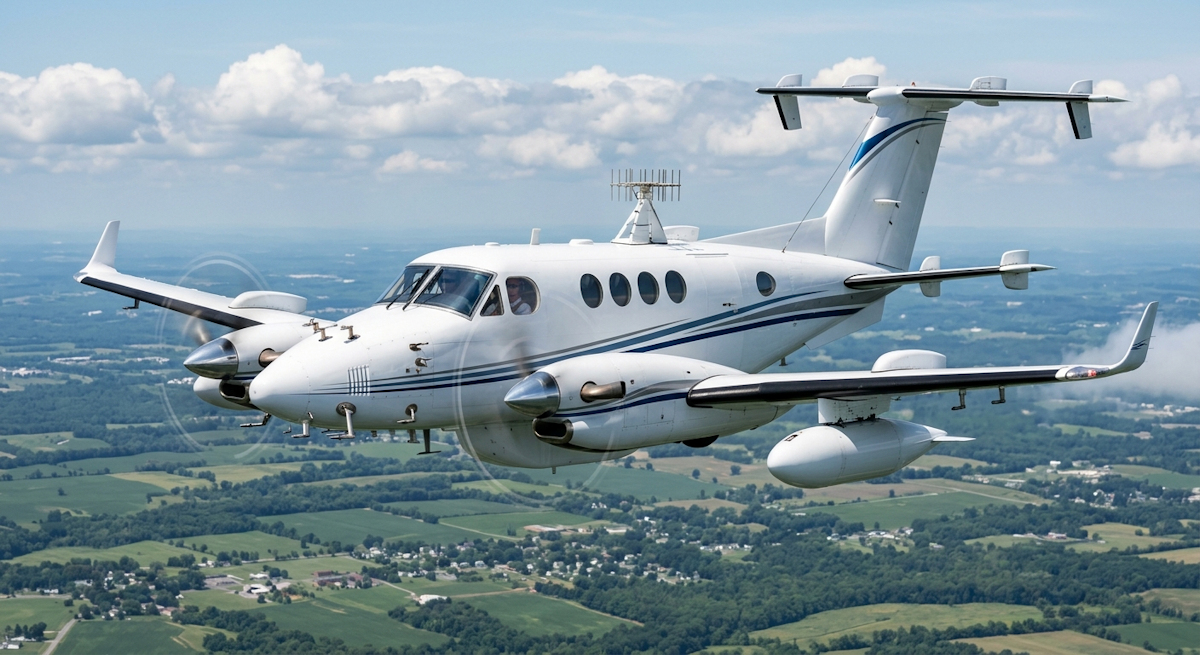
Analex Laboratories today reported the completion of a 400-flight campaign for ARGUS (Assurance Runtime Guardian and Unified Supervisor), a runtime assurance architecture that allows a neural network to perform a safety-critical airborne function while the certifiable logic stays entirely classical. Flying a modified Part 23 turboprop with a single test pilot and an instrumented safety observer, Analex exposed the system to 60 deliberate network "confusions" — adversarial visual scenes, a truck parked on the runway, an intruding drone, a flock, sensor dropouts and a simulated pitot blockage — plus crosswind landings, gust fronts and degraded-visibility approaches. In every case the deterministic envelope supervisor either let the network continue or took control, with a worst-case handover latency of 34 milliseconds and no transition to an unsafe state. The network handled 96.8% of flight phases without fallback; the out-of-distribution detector flagged 100% of injected out-of-domain cases with a 1.2% false-positive rate; and measured pilot workload on the NASA-TLX scale fell 41%. In three dedicated incapacitation runs the aircraft autonomously diverted, sequenced itself into the pattern and landed.
The architecture is deliberately built to sidestep the certification problem rather than solve it. ARGUS splits the system in two: a neural co-pilot that is useful but unproven, running at Design Assurance Level C on a 45-watt aviation-grade module with time-deterministic inference, and an ARGUS supervisor that is proven and boring — a classical, certifiable envelope and mode logic monitor running on a separate deterministic partition. The network can never command outside the supervisor's envelope, and the supervisor never has to be intelligent. Three functions make that defensible. A conformal-prediction validity estimator produces a calibrated, statistically bounded answer to "is the current situation inside the training domain," rather than a softmax confidence number that means nothing. A handover ledger records, for every decision, the network output, the validity metric, the supervisor's independent envelope check and the resulting action on a tamper-evident timeline — so a regulator can audit not what the network did but why it was allowed to. And a graceful degradation ladder gives the supervisor somewhere to go, from network-augmented control down through classical control to a fully coupled emergency profile, with no single step more than one automation level deep. "You cannot certify a neural network by testing it, and everybody in this industry has spent five years pretending otherwise," said Dr. Ananya Patel, Chief Director of Aerospace Technology & Engineering at Analex Laboratories. "The regulator is never going to sign off on a system whose behaviour is only described by a distribution. So we stopped asking ARGUS to prove the network was right. We built a fence, proved the fence, and then let the network do whatever it likes inside it. The network is not the certified artefact — the supervisor and the switch are. That is a much smaller thing to certify, and it is the only version of this that has a route to a signature."
Analex was blunt about what the campaign did not establish. The supervisor bounds the consequences of a bad network decision, not the frequency — ARGUS does not make a poor network good, and the team's false-positive rate means roughly one in eighty encounters triggers an unnecessary handover, which on its own is a utility problem, not a safety one, until it happens during a critical phase. The validity estimator is also structurally blind to unknown unknowns: it can prove you are inside the training domain, and cannot prove the training domain was the right one to build. The company's mitigation is an explicit operational design domain declaration for each installation, and a rule that any flight outside the declared domain reverts to classical control by default rather than by exception. Analex has released the handover-ledger format, the injected-confusion test library and the calibration methodology, and says the ledger was designed to be readable by an authority rather than by an engineer.
The timing targets a field that has flown well ahead of its paperwork. DARPA's VENOM put a front-line F-16 under full AI control in July; Reliable Robotics is assembling a certification case for uncrewed cargo with FAA eIPP support; Merlin is flying an autonomous KC-135; Wisk's pilotless Gen-6 has flown but its parent is now Archer. Yet EASA's June 2026 Concept Paper still caps machine learning at DAL C, no authority has published final ML means of compliance, and no regulator has approved single-pilot airline operations above 19 seats. Against that backdrop Analex is positioning ARGUS as the missing assurance layer rather than a better autopilot, selling to autonomy developers who need a certifiable wrapper and to airframers who want the co-pilot without the certification risk. "Garmin's Autoland works because it is allowed to be dumb," Patel added. "It picks one emergency and nails it. Everything clever in this industry is trying to get out from under that. ARGUS is how you get to be clever and still sign the page — you keep a dumb supervisor watching, you pay the price in false positives, and you never, ever let the network hold the last line." A certification-grade ARGUS installation is targeted for submission to EASA and the FAA in 2028, with a parallel build for a rotorcraft platform following the supervisor's adaptation to automated autorotation.